

Hooked or Hookless Rims?
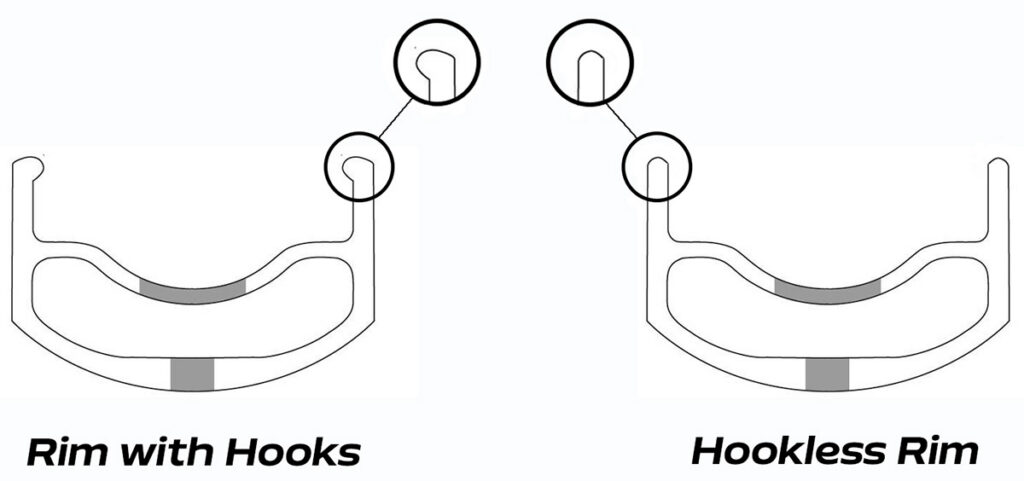
As far as tires are concerned, bicycle rims come in two types: rims with hooks (left) and hookless rims (right). The difference is the ‘hook’—the little lip you see at the top of the sidewall.
If you are setting up your tires tubeless, then it’s important to know which type of rim you have. The maximum tire pressure can be different—as defined by the ETRTO standards that govern bicycle tires and rims. For tubeless setups, hookless rims have lower pressure ratings that depend on the width of your tires:
- 25–29 mm: 5 bar (72 psi)
- 30–34 mm: 4.5 bar (65 psi)
- 35–39 mm: 4 bar (58 psi)
- 40–44 mm: 3.5 bar (51 psi)
- 45–54 mm: 3 bar (44 psi)
- 55–64 mm: 2.5 bar (36 psi)
Also make sure to check the pressure rating of your tire and your rim. The maximum pressure of your system is the lower of these three values:
- table above
- max. tire pressure
- max. rim pressure
What if you need higher pressure than the table above allows? You can always run tubes. Tubes reinforce the joint between rim and tire, which greatly reduces the risk of tire blow-offs. Many tires have a higher pressure rating with tubes than tubeless, and the table above applies only to tubeless setups. Just make sure to check the maximum pressure of your rim, too. And make sure you’re running high-quality rims that meet the ETRTO standards.

Why do some rims have hooks and others not? The hook interlocks with the tire’s bead and prevents it from sliding upward. This adds an extra factor of safety against the tire blowing off the rim, even if the fit between rim and tire is not ideal.
Does that mean rims without a hook are unsafe? Not at all.
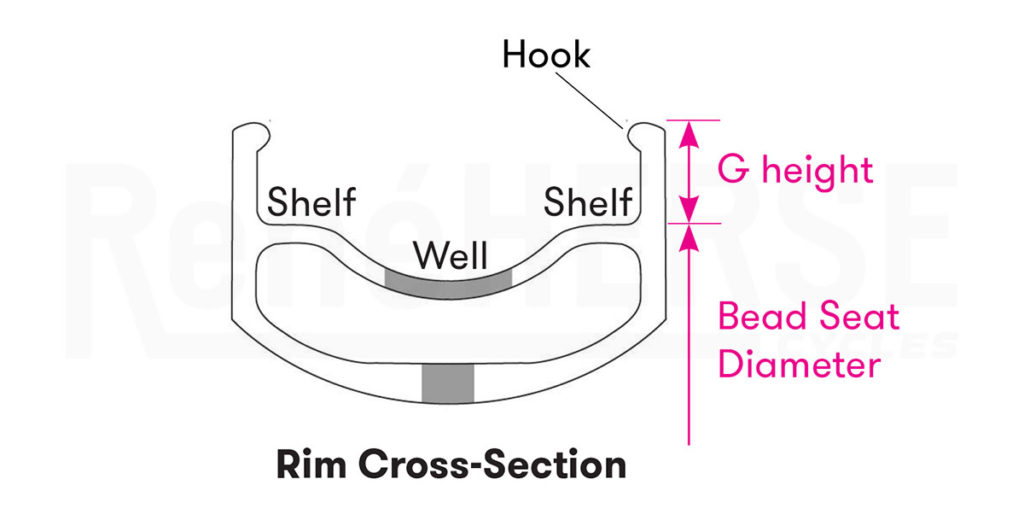
The essential part of any rim is the bead seat diameter—where the tire sits on the rim. If that diameter is within the correct tolerances, the tire sits tightly on the rim, and there is little risk of it blowing off. If the tire can’t move upward, there’s no need for a hook that holds the tire back.
If you’re curious about the tech behind all this, read on… (If you just want to know how much to inflate your tires, go straight to the Rene Herse Tire Pressure Calculator.)
Why don’t all rims have hooks?
With aluminum rims, the hook is easy to make. Aluminum rims are extruded: Imagine squeezing toothpaste, but the tube’s opening is shaped like the cross-section of the rim. You can create any shape that way. The extrusion is then rolled into a circle to form the rim. However, that process is not very precise, so the diameter of the rim can vary a little bit. That’s why aluminum rims need a hook as insurance, if you end up with a rim that’s a little smaller than ideal.
Carbon rims are made in molds. The molds are designed so you can get the rim out after the carbon material has cured. With a hookless rim, that’s easy: Just move the part of the mold that creates the inside of the rim above the rim bed upward. With a hook, it gets complicated—the hook interlocks with the mold just like it does with the tire bead. One solution is to make the inside of the rim with an inflatable bladder rather than rigid. Deflate the bladder, and you can remove it from the finished rim. But a bladder is flexible, so the rim dimensions will not be as precise. As we’ve seen above, precise dimensions are more important than a hook. That’s why many carbon rims are hookless.
An alternative approach is to use a multi-piece mold insert, with a middle piece that gets removed first, which then allows the side pieces to slide toward the center, so they can be removed as well. However, a multi-piece mold adds cost and complication…
Take a moment to check whether your rims have hooks or not. As to the tire pressure you want to run—which usually is much less than the maximum pressure you can run—check out the Rene Herse Tire Pressure Calculator.