

3 Take-Aways from the 2026 Tour de France
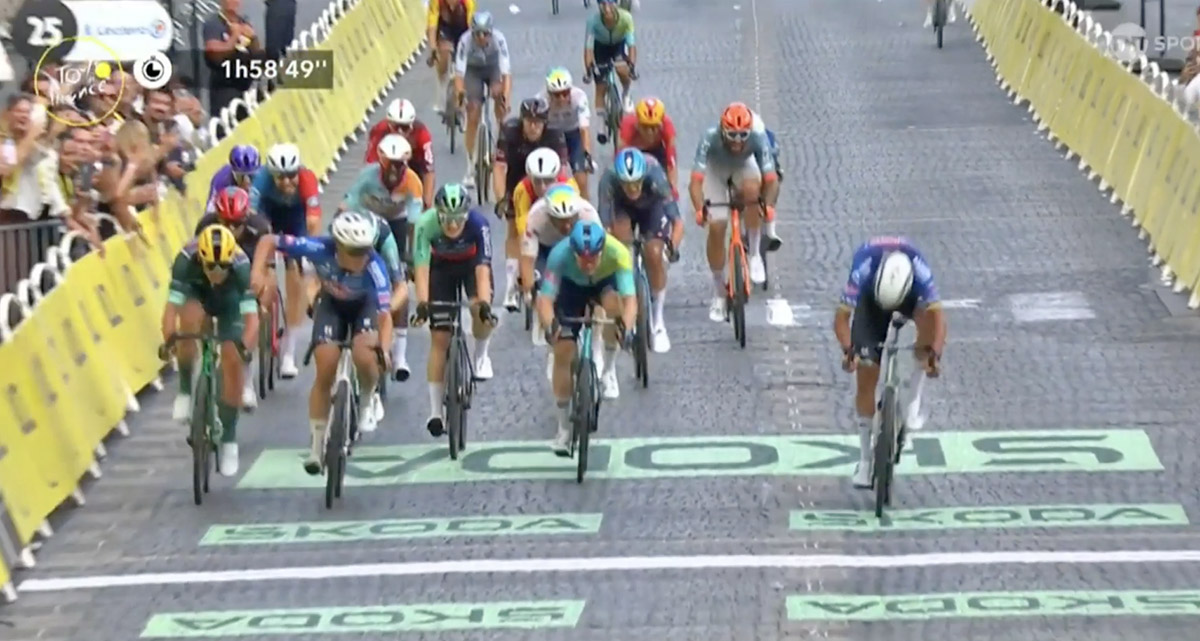
If you’ve followed the last stage of this year’s Tour, you’ve witnessed one of the most exciting finales in decades—perhaps since Greg LeMond blasted past the Arc de Triomphe to win the 1989 Tour by just 8 seconds.
This year’s final stage was shortened to keep the race inside Paris. This freed up emergency services, who were urgently needed to battle forest fires that are raging in France.
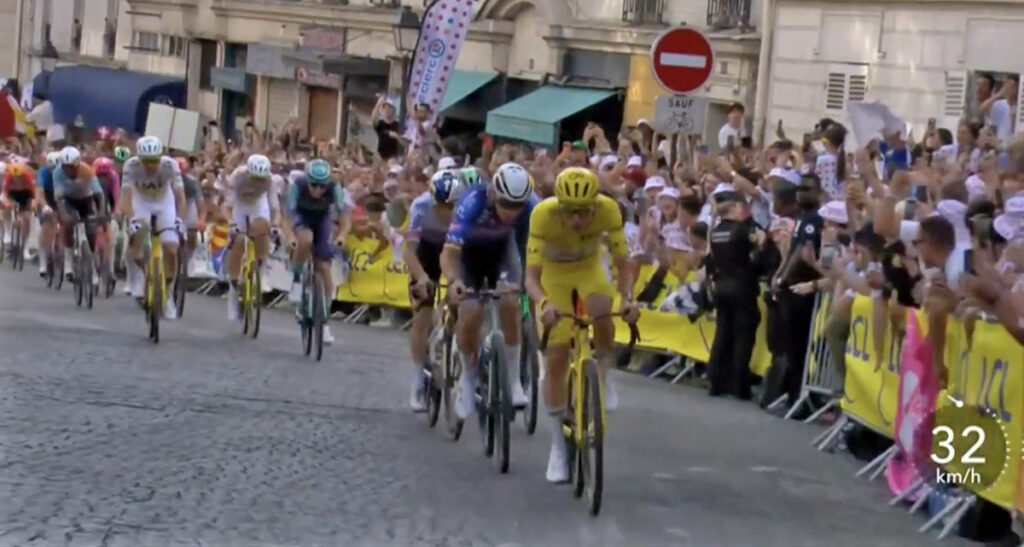
As tragic as those events are, the final stage of the Tour was probably all the better for turning into a circuit race that climbed the cobbled streets of Montmartre not just once, but three times. Attacks followed each other in quick succession. All were caught by the peloton, until Mathieu Van der Poel and yellow jersey Tadej Pogačar broke clear on the last ascent of the famous hill. The chasing peloton was never far behind. Pogačar was overtaken on the finishing straight, on the Champs Elysées, while Van der Poel was able to hold off the charging peloton to win the final stage—by less than a bike length!
It was a remarkable finale that also drove home three big take-aways from the 2026 Tour. The illustrations for this article are stills taken from the official Tour race feed, which is available to the press in real time.
1 Wide tires have changed the race
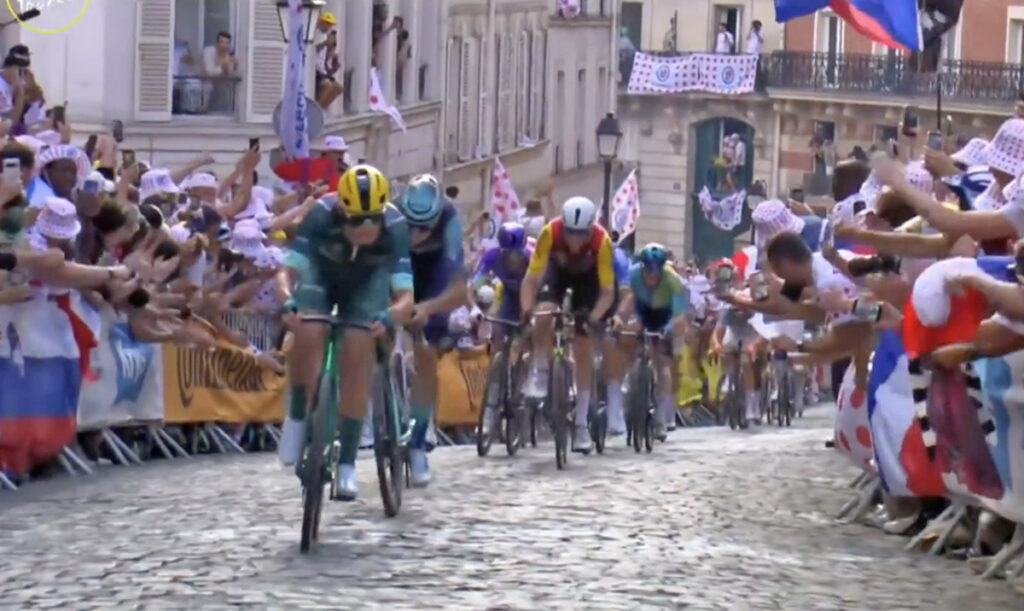
Seeing the pros on bikes that could be mistaken for cyclocross bikes—with 30+ mm tires—is truly remarkable. Anybody who has ridden up the rue Lepic in Montmartre knows that those cobbles aren’t smooth. In the past, no route designer would have included that climb in a Tour stage. Rough cobbles were found only in Paris-Roubaix and the Belgian classics. (The cobbles on the Champs Elysées are much smoother. They’ve been part of the Tour for decades.)
The cobbles were rough, and yet the racers climbed the 8% hill as if it was paved. Gone are the days when cobbled climbs saw grimacing racers wrestling with their bucking and bouncing bikes… Most of the nominally 28 or 30 mm tires that riders used yesterday were actually quite a bit larger on today’s wide rims—up to 34 mm as measured by Bikeradar.com. Yesterday, racers rolled on twice (!) the air volume compared to the 23 mm rubber that was standard not long ago. Seeing these racers attack, climb and descend on the rough cobbles as if they were smooth pavement shows how far the wide-tire revolution has come: It’s not just changing the bikes, but also the race itself—for the better.
However, the often-heard mantra ‘Wider is Faster’ does not apply to all conditions. For the time trials earlier in the Tour, quite a few teams downsized to 25 mm tires. Their testing seems to match what we discovered during our real-road tire tests: On smooth roads, the speed benefits of wide tires plateau above 25 mm. In other words, 25 mm tires are significantly faster than 23 and 20 mm, but going even wider doesn’t bring further speed benefits. It’s easier to optimize aero rims for narrow tires, hence it makes sense to go with 25 mm tires in time trials, where aero is the most important consideration. Of course, this also depends on each team’s wheel supplier: For which tire size are their rims optimized?
During road stages, 25 mm tires are definitely a thing of the past. Yesterday’s stage showed the benefits of wider rubber: Better shock absorption reduces rolling resistance on rough surfaces—especially cobblestones. A larger contact patch—thanks to lower pressure—results in better cornering grip. That same low pressure also makes punctures less frequent—the soft tires deform around debris that would puncture a narrower, harder tire. For today’s pros, these benefits clearly outweigh the small weight penalty of the larger tires. (Interestingly, many bikes this year were significantly above the 6.8 kg limit.)
What this means for the rest of us
The benefits of wide, supple tires are available to all riders, at all speeds. In fact, most of us may want to upsize our tires beyond what the pros ride. Pro racers are light, and high speeds smooth out the bumps. To get the same comfort and performance, most of us will want to try 35 or even 38 mm tires. The benefits of speed, grip and fewer punctures are as real for us as they are for pro racers. The added comfort of wider rubber is a bonus that may not matter all that much in the Tour, but it will make our rides even more enjoyable.
Aero is Powerful
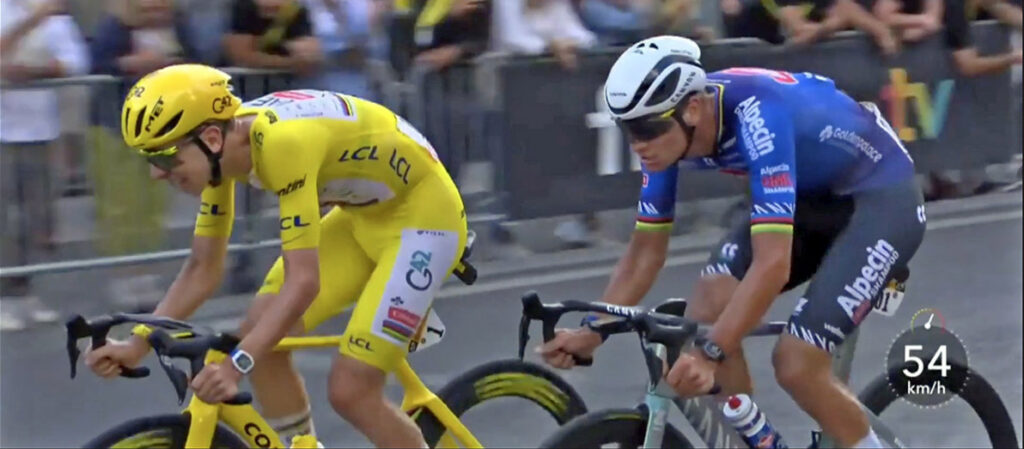
Seeing Van der Poel and Pogačar cruise at 54 km/h (34 mph) underlined the importance of aerodynamics in pro racing. Both were wearing skinsuits, which in the past were reserved for time trials. However, their riding positions are not very different from racers in decades past. Even in the drops, Van der Poel’s and Pogačar’s backs are no more inclined than mine when I raced many years ago. Today’s handlebars are lower, but that’s mostly because the reach of modern bikes is so short. Do the almost vertical arms work as fairings that shield the riders’ legs? The image above suggests this might be the case. Or would a higher and more forward handlebar position make the arms more horizontal and be even more aero? Without wind tunnel data, it’s impossible to tell. However, one thing is clear: How low racers are on their bikes during all-out efforts has not changed much in more than half a century. In the end, human anatomy is still the same…
What this means for the rest of us
In theory, the gains of optimized aero are present at all speeds, but they diminish rapidly as speeds go down. Squeezing ourselves into skinsuits for group rides will have negligible benefits. Aero-optimized bikes make sense when split-seconds count—Van der Poel won the stage by less than 1/10 second. For the rest of us, the benefits are smaller than many cyclists think: 1/10 of a second won’t change the cycling experience for most of us! Once we’ve made sure that our clothing doesn’t flap in the wind, our bars aren’t overly wide, and our position is as inclined as our flexibility and power allow, further aero gains will be relatively small.
Power (and Training) is Everything
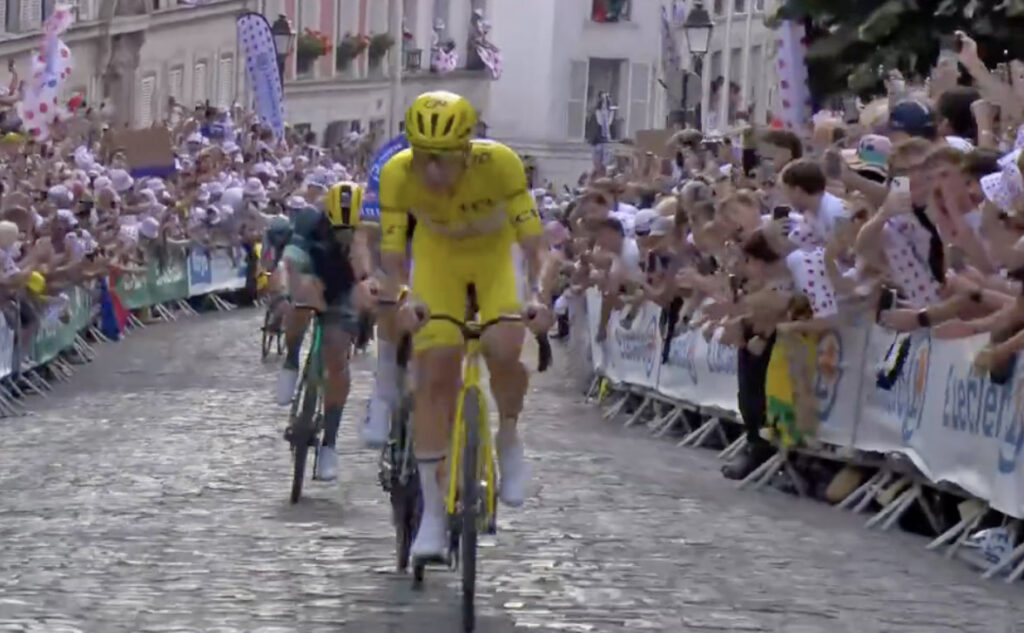
Pogačar won the tour convincingly, even though his tires were no wider than those of other racers, and his bike was no more aero. He’s a remarkable athlete whose power and endurance are untouchable at the moment. He won the Tour because he was the strongest rider in the peloton.
Wide tires and aero-optimized bikes and clothing explain a small part of the recent performance gains in the big tours. Most of the speed increase comes down to a simple fact: Today’s racers put out more power than previous generations. And they do so consistently over the entire Tour de France, not just for a single stage. That’s why the speed increases in the Tour have been much greater than in single-day classics. Training, nutrition, even resting and sleeping—everything is more scientific these days, and the gains are obvious.
What this means for the rest of us
Pro racers are close to the limits of their power, and they have to work incredibly hard for any additional improvements. For most of us, there is a lot more potential for increasing our power. It’s difficult to improve our aero by more than 10%. And most of us are riding on supple tires already. But 10% more power is attainable for many of us. There’s no need to hire a coach—although it can help. One or two interval sessions a week, plus plenty of rest and a good diet, will have greater benefits than chasing marginal gains on our bikes. (And for those of us who don’t care about speed, there’s nothing wrong with that, either.)
Conclusion
Two factors that have transformed the Tour provide the same benefits for racers and non-racers alike. In fact, wide, supple tires were adopted by recreational riders before they entered the Tour peloton. Improved training methods have similar effects for amateurs and recreational riders. Both not only make us faster, but can also make our riding more enjoyable.
By comparison, marginal aero gains are a bit like the large wings found on today’s sports cars. They provide tangible benefits mostly at racing speeds. For the rest of us, they are as much about aesthetics as they are about improving performance—and there’s nothing wrong with that. Because in the end, it’s all about making cycling more fun: for us as we ride, but also as we watch the pros. And it’s nice to think that wider tires and more speed make the racing more fun for the pros, too.
P.S.: To our readers in France, Spain and everywhere where fires are raging: Our thoughts are with all whose homes, communities and places they love have been lost or are threatened. Seeing places I’ve ridden through many times during my visits to Paris burning has been heart-breaking. We also appreciate the valiant firefighters, pilots and volunteers working tirelessly to contain the fires and help those who are affected.