


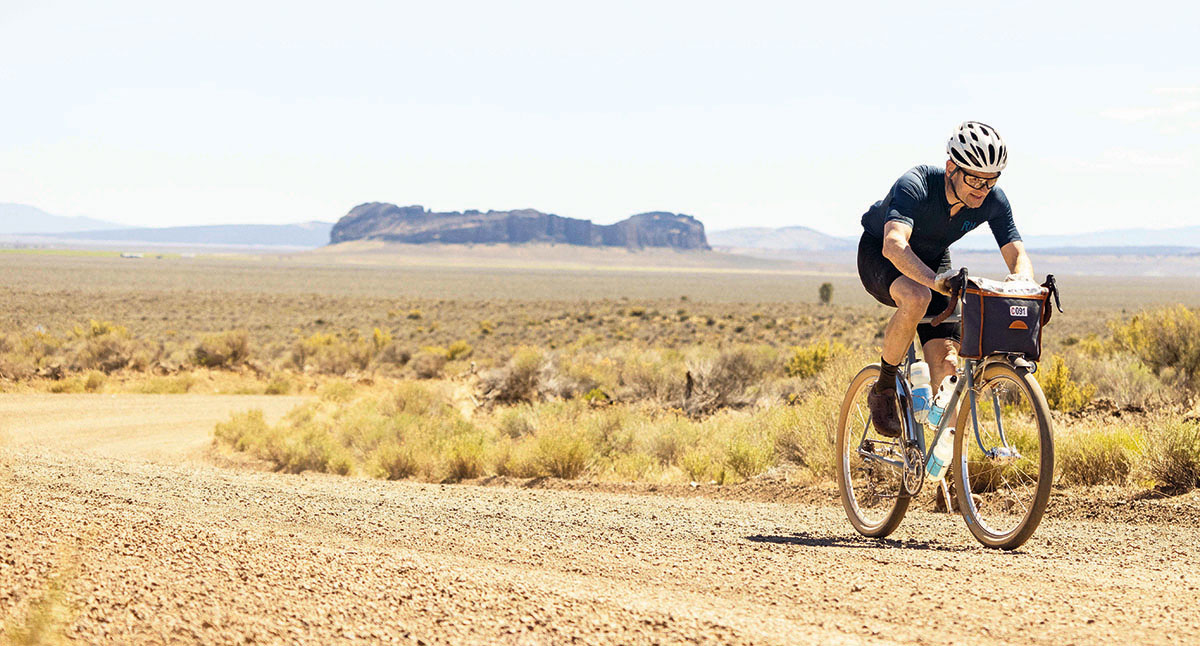
5 Years Ago: Oregon Outback FKT
Five years ago, I was pedaling into a glorious morning. The sun had just come up. Recent rains had cleared the air. Drops of dew were glistening on the grasses and trees along the trail. The morning—and my ride—were full of promise. Not only was I going to ride my bike all day, on a course I love, but this was also the culmination of more than a decade of exciting discoveries. Yes, I was heading out to try and set an FKT (Fastest Known Time) on the 585-km (364-mile) Oregon Outback. At the same time, my ride was also a proof-of-concept of the idea that a bike with ultra-wide tires could roll over rough gravel at road-bike speeds.
With all that promise came some trepidation: Could I maintain my speed for 26+ hours? Would my 54 mm tires really float over the gravel where previous riders had sank deep into the loose surface? Would my Extralight tires be tough enough for the rough trails of the Oregon Outback? Furthermore, the equinox was hardly the best time for an FKT attempt, since it meant riding almost as much in the dark as in daylight. All summer, terrible fires made the Oregon Outback impassable. Now the fires had finally stopped burning, and the first autumn rains had cleared the smoke. That brought up another question: Was the route even rideable any longer?
Once I’d left Klamath Falls on my northward jorney, most of these concerns were beyond my control. All I had to do from now on was ride my bike as fast as I could.
This wasn’t going to be easy: The FKT of 27:27 hours was held by Steve Hartzel, one of Portland’s fastest cyclocross racers. Earlier that year, Lael Wilcox had set the women’s FKT, 27:58 hours, as final preparation for Unbound XL, which she won a few weeks later. To better those times, I would need every advantage I could get.
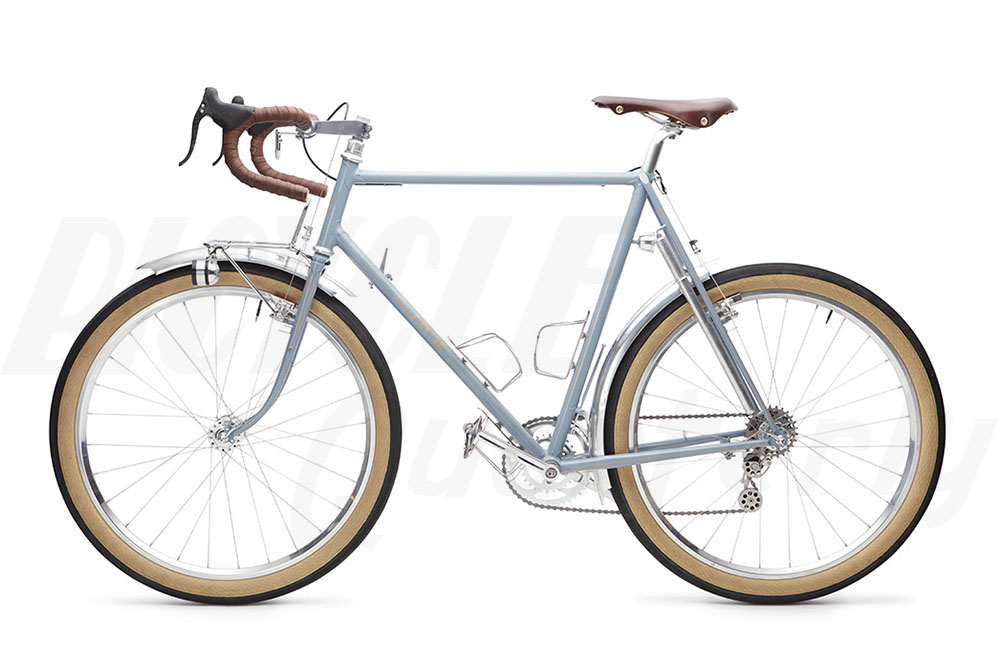
My bike incorporated all we’d learned during a decade of researching tires, aerodynamics, and other aspects of bicycle performance. Many of the ideas that were pretty far out just five years ago are now accepted in the mainstream. It’s hard to believe, but in 2021, gravel racers still worried about ‘too much tire’ for a given course. Most ran 38 mm tires, and 42s were considered ultra-wide, suitable only for exceptionally rough courses like Unbound. I had build my bike around 54 mm tires, because our research suggested that they’d be faster on the rough and loose gravel of the Oregon Outback.
Tires were (relatively) narrow back then, but handlebars were wide. Perhaps influenced by mountain bikes, most gravel racers used 44 cm handlebars. However, our wind tunnel tests had shown that reducing the rider’s frontal area was the best way to improve aerodynamics. My 40 cm bars measured just 36 cm over the tops. Today, we all know that, over the past five years, mainstream cycling has caught up: 54 mm tires and 40/36 cm bars aren’t crazy any longer.
Some other aspects of my bike haven’t been picked up in the mainstream (yet). Also based on our wind tunnel tests, I made fairings from cut-down fenders, to shield the tire treads from the onrushing air. The idea is less outlandish than it may appear: Moto GP bikes use similar fairings. The other surprise to many observers were the 26″ wheels of my bike. Our testing on rumble strips had shown that smaller wheels don’t roll slower on gravel. Smaller wheels were lighter, plus they allowed for a shorter, lighter frame, lower Q factor and other advantages.
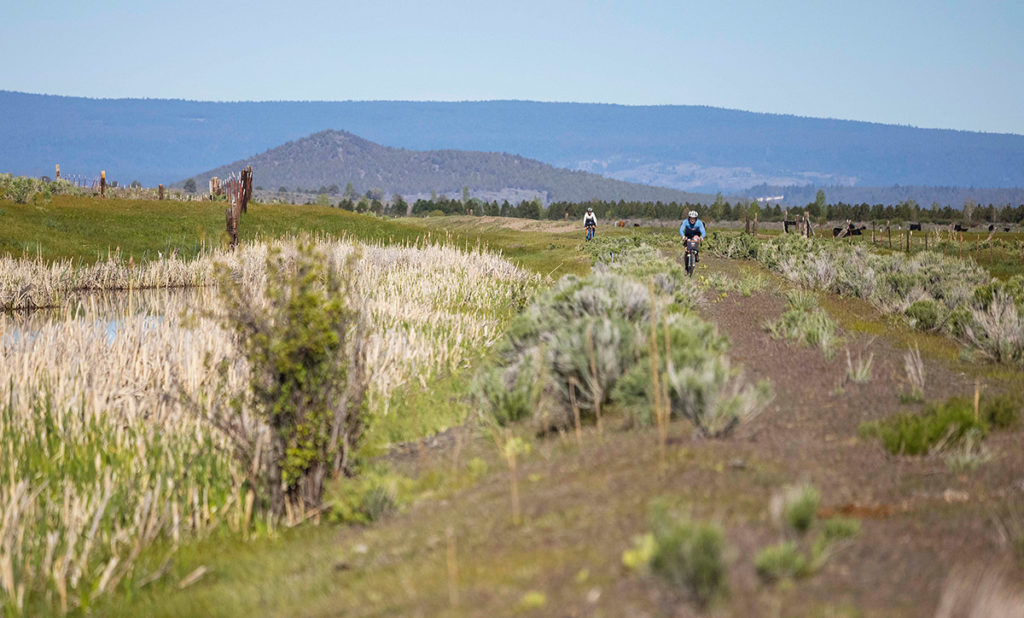
My ride over the Oregon Outback was a test of whether all this science really worked in the real world and not just in our carefully controlled tests. Would I really be able to ride across the rough terrain of the Oregon Outback at road bike speed? (Above, with Lael during our earlier ride.) To succeed in setting the FKT, I would need good legs and a (very) good bike.
With the rising sun, a light headwind had sprung up, but it didn’t seem to slow me much. I was pushing the limits of my fastest long-distance pace. A car racer, John Cobb, once said of setting a speed record on the Brooklands track in Britain that is was like “seeing how far one could lean out of a window without falling out.” That’s how it felt on that day: I was at the ragged edge of what my body could do. However, where Cobb risked life and limb if he pushed too far on the steeply banked track, I only had to worry about not being able to maintain my pace to the finish.
Even so, this was going to be an adventure. I had prepared my ride, but there had been no time to devise back-up plans. I took the train to Klamath Falls, alone. I was completely unsupported. If the course was not rideable, if my bike broke, if I ran out of energy, I’d have to improvise. That didn’t mean that I was foolhardy: Eastern Oregon is remote, but a day of walking would get me back to civilization from any point of the course. More than anything, having no backup plan sharpened my sense of living in the moment, with a total focus on my ride.
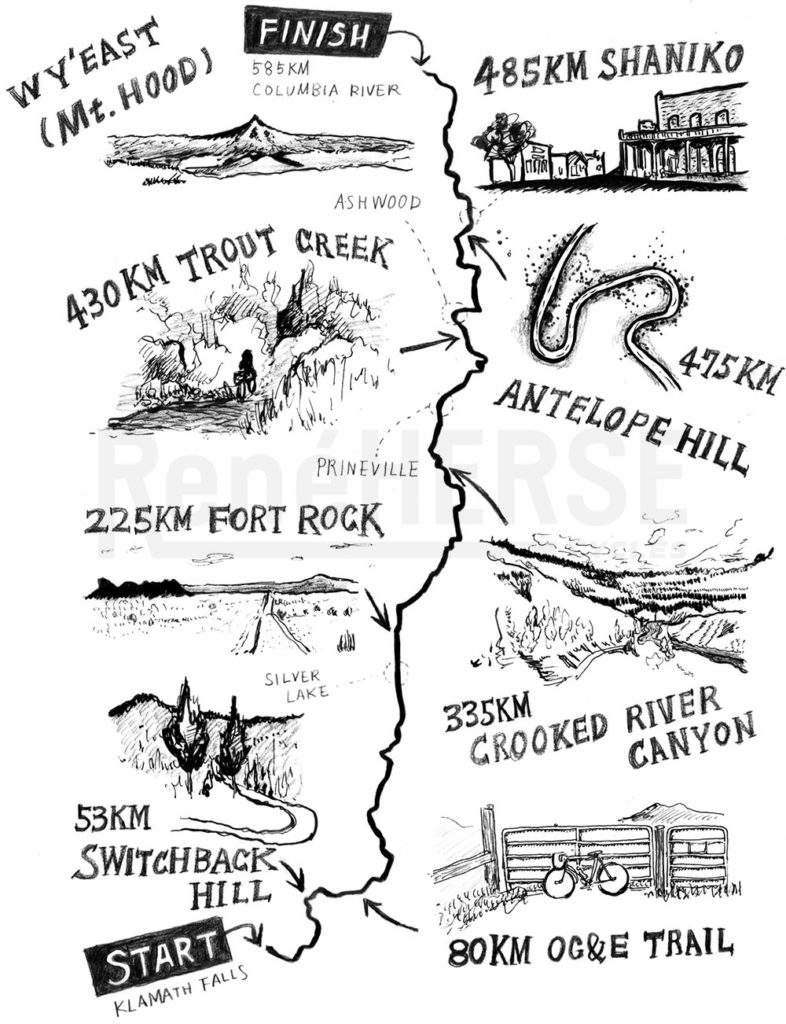
It’s rare that everything comes together perfectly for such a long ride, but when it does, it’s an amazing experience. My bike, my body, the weather, the terrain—everything worked in perfect harmony (or so it seemed). There was little time for photos, so Natsuko drew this sweet map, with highlights of the course.
Climbing Switchback Hill, the air was so clear that it was impossible to judge distances. What looked like small trees nearby turned out to be tall trees that were far away. The ochres and dark greens of the dry landscape contrasted with the cerulean blue of the sky. Eastern Oregon was achingly beautiful. FKT or not, I was just happy to be out there riding my bike!
The OC&E trail runs through cattle pastures, and there are dozens of gates that riders have to open and close. Cyclocross dismounts helped minimize the time loss. Then I was already in Silver Lake, the first resupply stop. I didn’t waste much time, and continued on the long stretches of soft gravel that make up the middle part of the course. Fort Rock passed, and my bike floated on top of the loose and soft gravel where it had sunk in 2014, during the inaugural Oregon Outback race that I rode on 42 mm tires. The long straights that seemed interminable then now flew by at speed.
The sun set as I headed into the Crooked River Canyon. It was pitch dark for a couple of hours, adding excitement to the long descent on loose gravel. Then the moon rose. It was almost full, and it painted the cliffs of the canyon in a silvery light. It felt like riding through one of Ansel Adams’ famous night-time photos. It was incredible, and worth the effort all by itself.
After a second—and last—resupply in Prineville, the Ochoco Mountains are the ‘moment of truth’ on any fast ride over the Oregon Outback. If you’ve overdone it during the first half of the route, the long climbs will slow you to a crawl. On this day, I had gauged my effort well. My legs were tired, but riding through the moonlit landscape gave me a boost of energy. I really enjoyed the twisty gravel descents. There was no traffic at all—I didn’t see a single car in the five or six hours it took me to get through the mountains. The famous crossings of Trout Creek were almost dry, so I rode them at speed. My bike bounced across the huge cobbles that make up the riverbed. I wasn’t sleepy before, but I certainly was wide-awake afterward!
Climbing Antelope Hill on smooth pavement, I turned off my headlight, so bright was the moon. My legs had little twinges of cramps—I’d forgotten to bring electrolyte tablets, and I’d been pushing the pace for 19 hours now—but I knew that they’d be fine. As I cycled through the fast-asleep town of Shaniko at the top of this last big climb, I checked my schedule. I realized that the FKT was possible. That knowledge, and a light tailwind, made the next hours pass quickly.
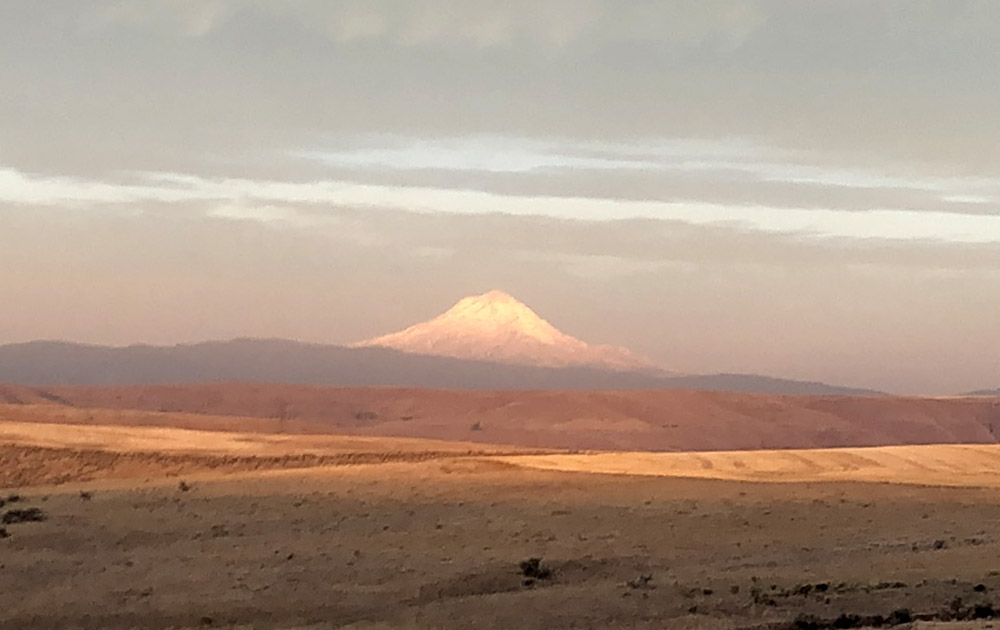
By the time the sun came up for the second time on this ride and illuminated Wy’East (Mount Hood) in the orange morning glow, I was battling many short, but steep climbs on farm roads that run toward the Columbia River. The last climb, up Gordon Ridge, showed how close I had judged my effort. As the top came into sight, I wanted to accelerate—but my legs had nothing left. Then came the incredible 13-mile (20 km) descent into the Columbia River Gorge. The wind whistled in my ears as the bike danced on the loose gravel. It was a fitting finale to a great ride.
I sprinted the last mile on a flat road along the mighty Columbia River and turned into Dechutes River Park. My watch showed 8:43 a.m.: My ride had taken 26:13 hours. I had taken almost four hours (!) off my 2014 time, and more than an hour off the FKT.
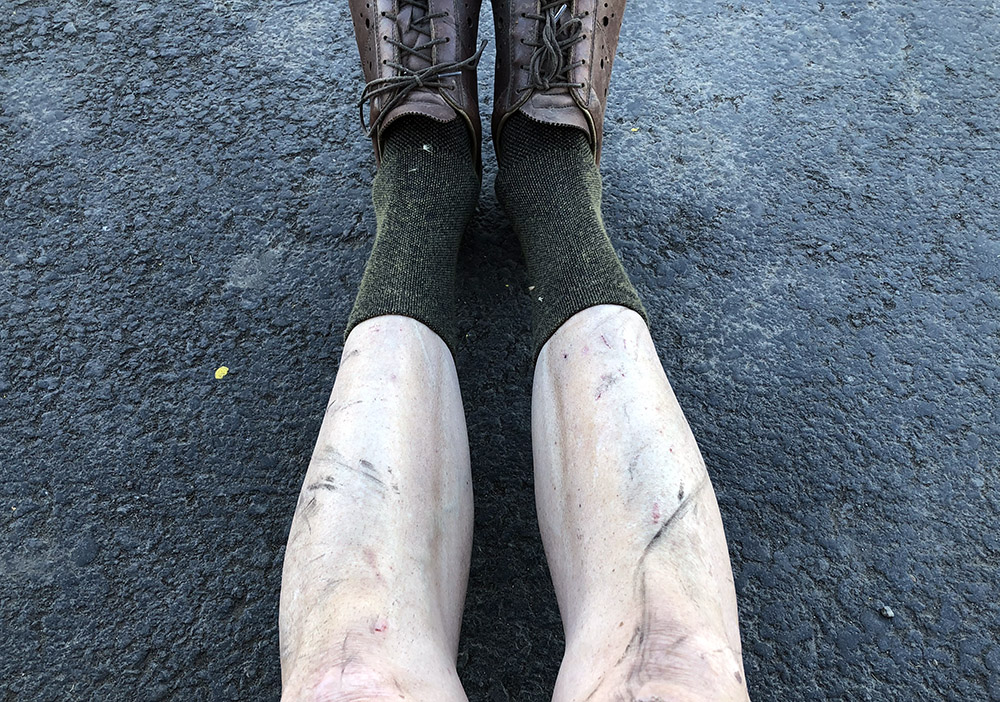
To put that time into perspective, it’s not far off what I’d expect for a solo effort in a hilly 600 km brevet—on pavement. The Oregon Outback course was 75% gravel, and much of it was rough. In fact, the trails were so overgrown that my legs were streaked with charcoal from brushing against vegetation that had burned in the fires.
The finish was almost anticlimactic. I sat down on a bench in the park, still panting from the effort. It felt strange to just sit there, with no plan for how long to stay, or what to do next. For a day and a night, my entire focus had been on moving forward, as fast as possible. There was no need to think, just pedal, shift, brake, eat, drink. Listen to my body to gauge the effort, at the limit of what it could do, but never overdoing it. This single-minded focus was meditative in a way that I don’t experience often, especially for such a long period of time.
Now the clock had stopped ticking. My mind was still full of impressions from the ride. The beautiful landscapes. The incredibly blue sky. The moonlight. The way the bike floated across the bumpy trails, enticing me to pedal harder to smooth out the ride even more. The sights of Fort Rock and Wy’East. The road winding through the hills just before Silver Lake. The water of the Crooked River rushing over the rocks. The things you notice only on a bike.
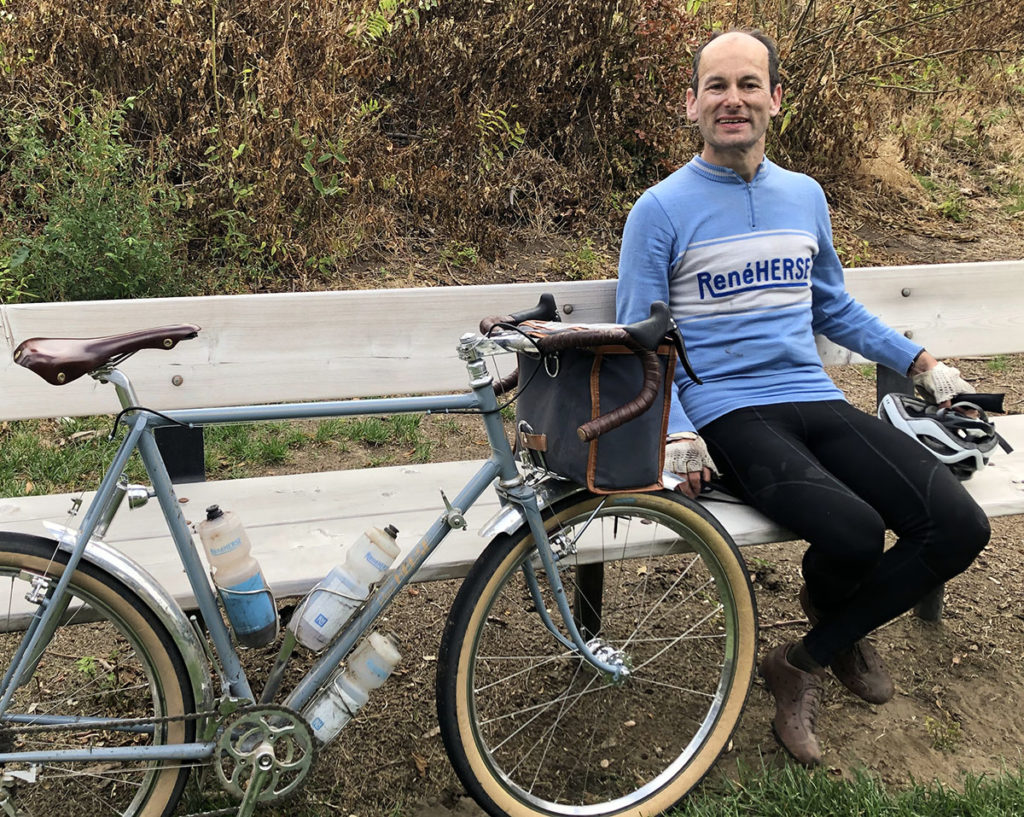
For now, just enjoyed the feeling of having achieved my goal. I had gone to the ragged edge, leaned out of the window as far as possible, but not fallen out. But I also knew that this alone would not have been enough to improve upon the times of riders faster and stronger than me. The proof-of-concept of a road bike with ultra-wide tires for rough gravel had been successful—and contributed significantly to the outcome of this adventure.
Slowly I came back to the real world. I had been so focused on my goal that I hadn’t really thought about what to do after I finished the ride. The big question was how to get to Portland. The train station was more than 100 miles away, into a headwind that was increasing in strength by the minute. Just as I pondered whether to take a nap or ride to the next town to get some food, a car pulled up, and the driver shouted “Congratulations!” He looked familiar, but I couldn’t place him at first. “Remember me? Mark—we raced together at the UW.” Suddenly, the memories came flooding back. Meeting for 5 a.m. training rides twice a week. Driving to races all over the Pacific Northwest in a big university van, loaded with a dozen bikes on the roof rack. Mark and I had lost touch after graduating, but here he was.
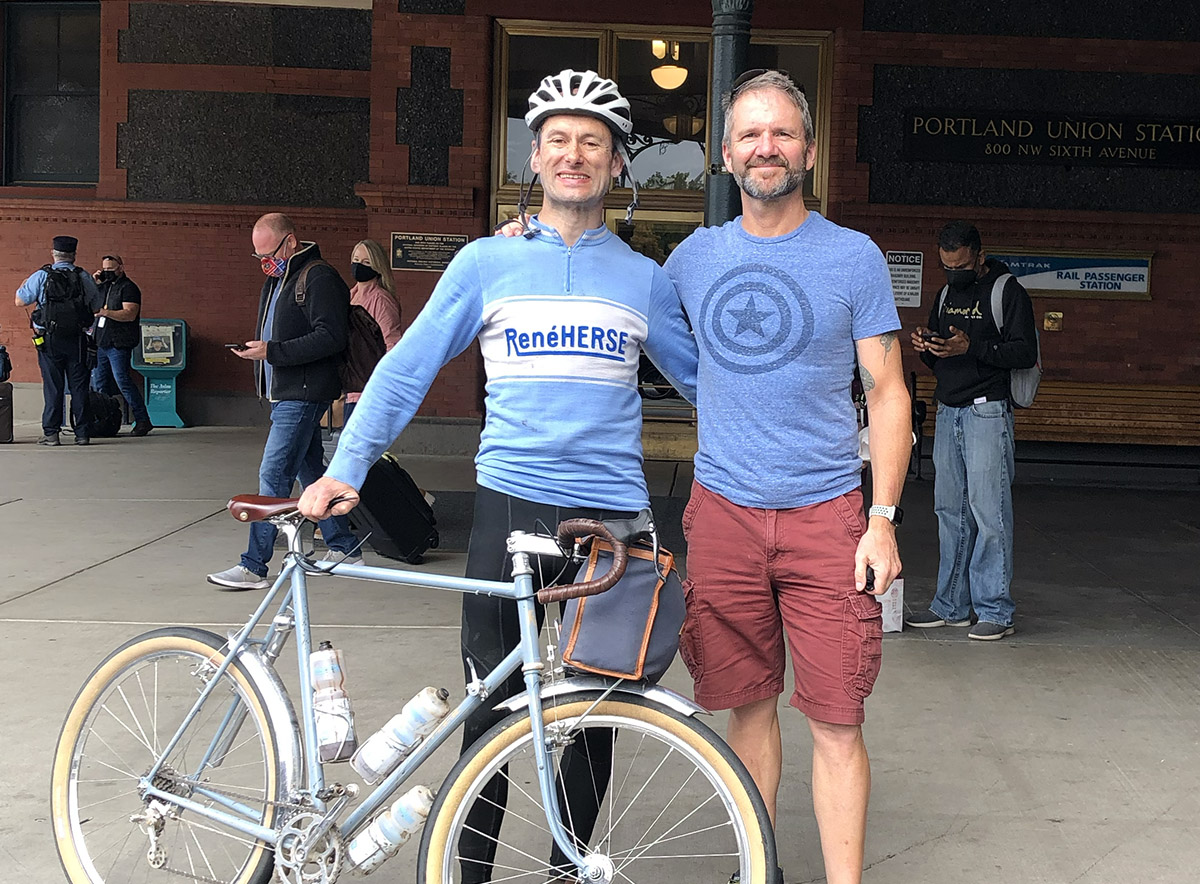
He had followed my ride on the GPS tracker. Since he lived nearby, he came to see me. He had timed his arrival a little after I finished, not wanting to intrude into what he assumed would be a celebration with my ‘team.’ He was surprised to find me sitting on a park bench—alone. ‘Unsupported’ really meant just that. He offered me a ride to the train station in Portland. Catching up with an old friend was a nice end to this incredible adventure (and solved the problem of how to get home). As so often, the best part of the adventure is the people we meet.
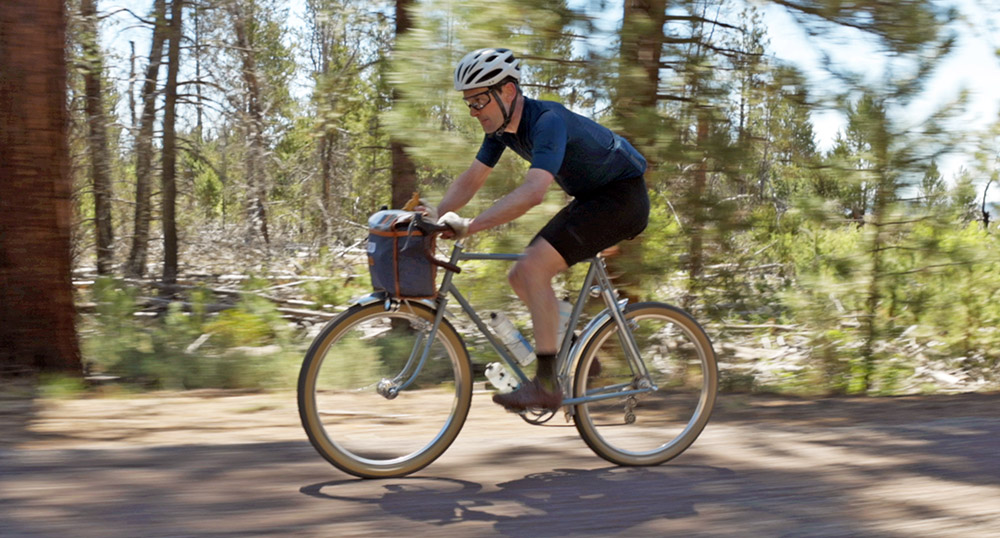
That was five years ago. Looking back, my bike still looks different from most people’s idea of the perfect long-distance gravel racer. However, key elements have become accepted by the mainstream. Wide tires are the most important one: Almost nobody talks about ‘too much tire’ any longer, and most of the latest gravel bikes clear 55 mm tires. Narrow handlebars have become so widespread that the UCI felt compelled to limit how narrow racers can go. It’s nice to see that science does win out in the end. More than that, however, I remember the pure fun and joy of riding the length of Oregon, and feeling my bike breathe with the rough surface, rather than bounce and buck over it. It was an exhilarating feeling, and it’s the reason I keep coming back to rides and adventures like these.
More Information:
- Oregon Outback Rene Herse: Method or Madness?
- Report after the FKT ride
- Our research into what makes bikes fast, comfortable and reliable is published in The All-Road Bike Revolution.
Photos: Rugile Kaladyte (Photos 1, 3 and 8; taken during the Spring 2021 ride), Mark Ahrens (Photos 6 and 7).