


New Study Confirms: High Pressure Not Faster
When we started testing tire performance 20 years ago, the most surprising finding was this: High pressure does not make tires faster.
That was totally unexpected, and it changed everything. It’s not just that we now ride our tires at lower, more comfortable pressures. Tire design itself has changed: We can now make tires that are wide and fast, whereas this was considered impossible before. Here’s why: With wide tires, you have to choose—supple casing or high pressure rating. With narrow tires, you can have both, but wide tires have more stress on the casing, so you need to beef up the casing if you want it to support high pressure. When we believed that high pressure was necessary for speed, a fast-and-wide tire seemed like an oxymoron—a nice idea, but physically impossible.
High pressure doesn’t make tires faster. The wide-tire revolution is based on this simple finding. Everything else follows from that. And the results are stunning: Compared to 2006, when we started out tire tests, today’s pros ride half as much pressure and 70% more volume in their tires. That’s a revolutionary change.
Low pressures really work: Average racing speeds have been going up, even as tire pressures have been going down. (The rest of us, who don’t race, aren’t riding slower, either.) This is now generally accepted—but science needs to be confirmed through independent studies. That’s why we are excited about new and rigorous research that confirms our findings. Ronan McLaughlin from the Escape Collective has done an amazing job testing tires on real roads. This is the sort of study we’ve been waiting for…
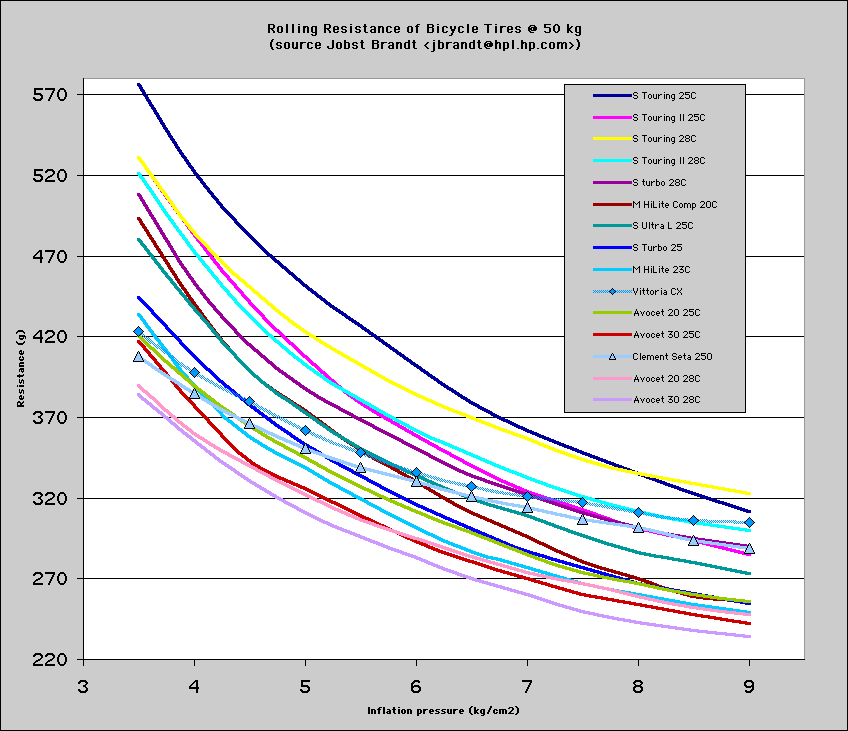
Before we dive into Ronan’s results, let’s look at where we started. Back in 2006, everybody—ourselves included—believed that high pressure was the most important factor for making tires roll fast. Above are typical tire test results from that era. In this lab test on a smooth steel roller, all tires had much lower rolling resistance at high pressure.
Take the fastest tire (Avocet 30 28C): It has about 350 g resistance at 4 bar (58 psi). At the same pressure, the slowest tire (Specialized Touring 25C) has almost twice as much resistance (550 g). But here’s the thing: If you want to make the slow Specialized even faster than the fast Avocet, all you have to do is double the pressure to 8 bar (115 psi). That lowers its resistance to just 340 g. (Of course, the Avocet would maintain its advantage if you doubled its pressure, too: At 8 bar, it has just 240 g resistance.)
On the smooth drum, pressure was the main determinant of performance—more than casing, tread pattern, rubber compound, or anything else. That’s why so many cyclists still believe that pumping up your tires harder will make them faster.
Note that the chart goes all the way to 9 bar—that’s 130 psi in U.S. units. And yes, we really did ride our tires that hard back then. Looking at this data from the early 2000s, you’d think that today’s pros are out of their minds, running their tires at just 4-5 bar.
As crazy as the chart above looks today, the drum tests weren’t wrong. They just didn’t measure the vibrations that slow the bike down. At higher pressure, the tire deforms less (which the drum tests measured), but vibrations increase (which the drum test did not measure). On real roads, the two effects cancel out, at least for supple high-performance tires. The result: Whether you run your tires at high or low pressure does not matter. They roll at the same speed.
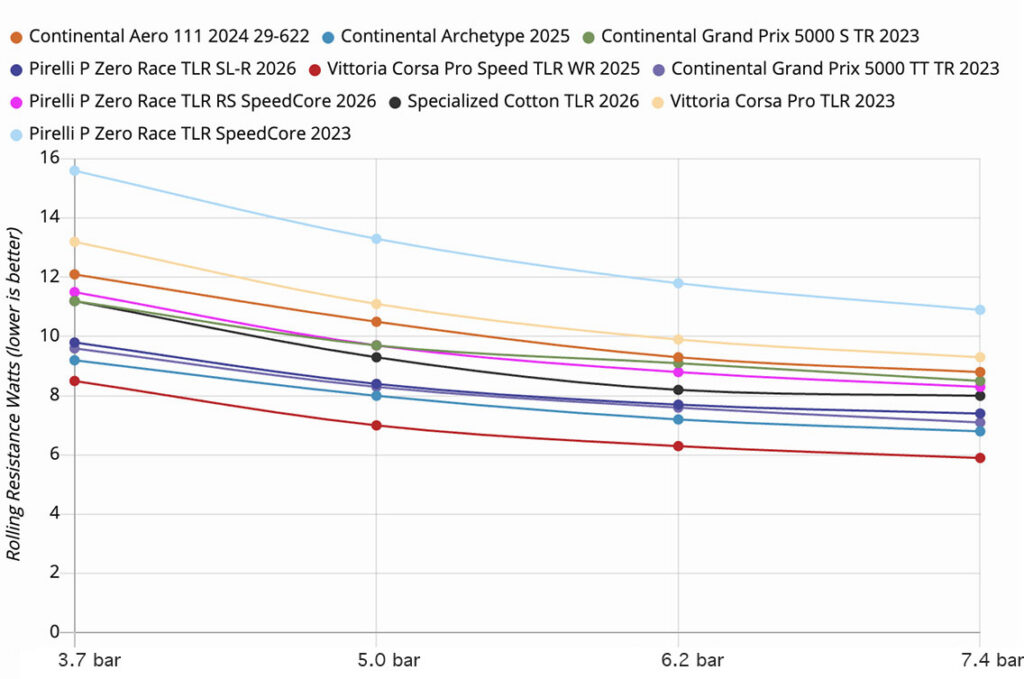
Here is a more recent drum test for 9 racing tires from bicyclerollingresistance.com. For this comparison, I chose the same tires that the Escape Collective tested on the road (below). All tires behave the same: The harder you inflate them, the faster they roll—on the drum. The slope looks shallower than in the earlier graph, because the vertical axis goes down all the way to 0. The old graph made the differences between tires more visible by cutting off the bottom portion and stretching the vertical axis.
There is another noteworthy difference: Today bicyclerollingresistance.com. calls 7.4 bar (108 psi) ‘ultra-high pressure.’ Nobody runs their tires at 9 bar (130 psi) anymore—not even riders who follow drum tests. However, the main conclusion hasn’t changed: If you test on a drum, without a rider, tires roll faster at higher pressures.
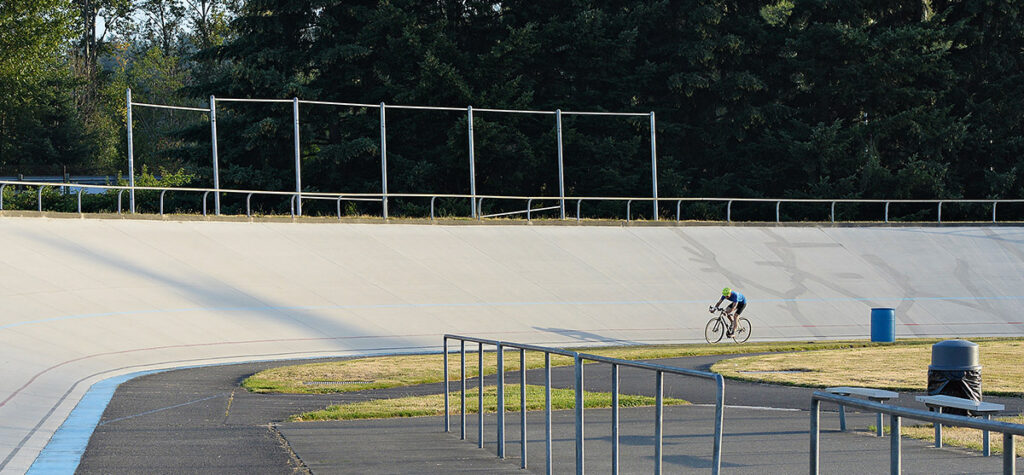
Our tests were different: We tested on real roads, with a rider on the bike. (Above we’re riding at the local velodrome, on the infield apron that’s paved with smooth asphalt.) We tested a variety of tires and measured power at different tire pressures. (We also did roll-down tests to make sure the results were the same with two different methods.)
We found that higher pressure does not make tires faster. Here’s why: High pressure increases vibrations, and these ‘suspension losses’ slow down the bike. At high pressure, you lose less energy to tire deformation and more energy to vibrations. The two cancel out—and the power is the same for a given speed, no matter whether you run high or low tire pressure. This applies to smooth roads and supple high-performance tires. (Of course, there is a lower limit to tire pressure. At some point, the tire becomes too wobbly to ride safely—and also very slow.)
Obviously, testing on real roads with a rider is more realistic than spinning a wheel on a steel drum, but it has its own challenges. There are many factors that influence bike performance, but we want to isolate just one: tire pressure. To figure out which tire pressure rolls fastest, all other factors need to be constant: wind, temperature, rider position, etc. That’s why outdoor testing requires very careful work. And then you need to check your results with a rigorous statistical analysis to see whether you’re really seeing differences in tire pressure or just ‘noise’—things like tiny variations in air currents, rider position, temperature, etc.
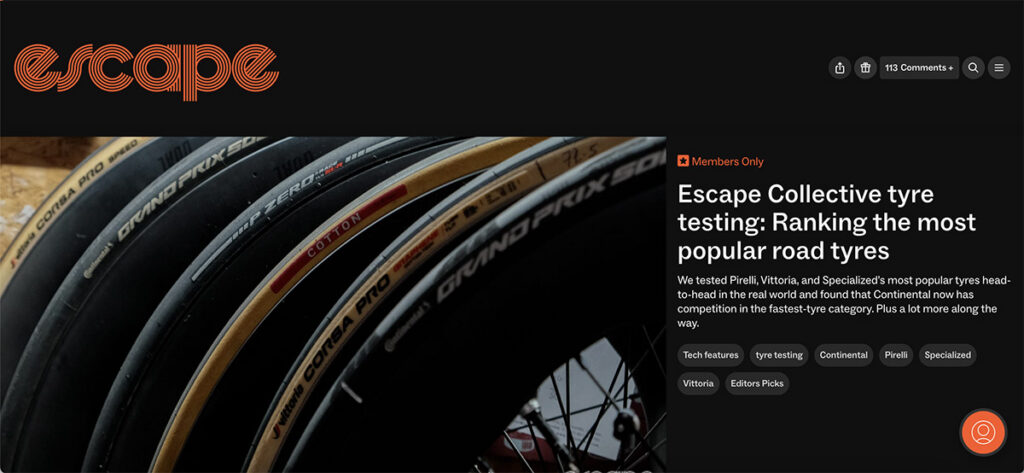
Over the past year-and-a-half, Ronan McLaughlin from the Escape Collective has used a similar methodology to test tires. As in Bicycle Quarterly’s testing, Ronan used the same bike, same wheelsets, same tester, and the same road. Similar to our testing, he also did repeat runs with a reference tire, to make sure nothing had changed over the course of his testing.
Ronan corrected for wind using Streamlines sensors that measure wind speed, direction, ambient conditions, body position, and elevation. That’s because he lives and tests in Ireland, where it tends to be windy. We’re in Seattle, where we have many days with absolutely still air. That’s why we were able to test with no wind and constant temperature, so we didn’t have to worry about those effects. Either approach can work. Sensors add a layer of complexity that has to be validated, but they expand the window of acceptable conditions for testing. It’s important to validate the results by testing the same tires multiple times. Obviously, the results should be the same every time. Actually, they won’t be exactly the same, because there is always a little noise in all data. The repeat runs allow you to estimate how precise your measurements really are.
As Ronan put it in the article: “Not measuring or reporting uncertainty and the test’s repeatability does not make a test more precise, it simply means we’ve no gauge of how precise that test is.” And yet that’s what other tests have done. Ronan continued: “The standardised baseline/control tyre that we run on every test day is absolutely critical to any testing, without it we’ve no way of knowing if we are comparing apples to apples, oranges, or carrots.”
If the baseline/control tire has the same results every time, you have shown two things: 1) that your results are repeatable and 2) that conditions haven’t changed since you ran your previous tests. Together, this guarantees that you’re actually measuring tire performance, and that other factors—wind, temperature, rider position—have not changed.
As Ronan found out, science is hard work: “I tested 10 different tyres across three different pressures each for a total of 50 different configurations (tyre and pressure combinations). Each test was done on the same stretch of road with a total of 75 runs (73 valid), 304 traverses of the out-and-back test segment for a total of 323 km of kilometres of testing and ~430 km of total riding including the roll into and spin down out of each traverse.” That sounds familiar: We’ve lost count how many times we circled the track, rolled down our test hills, and rode on rumble strips over the last 20 years.
Ronan was mostly interested in figuring out which race tires is fastest. (They didn’t test Rene Herse tires—the Escape Collective has a long-standing preference for big mainstream brands. This means there are no conflicts of interest when we talk about the results.)
It’s refreshing to see an article about bicycle performance acknowledge the limitations of the testing. Ronan wrote: “Around two watts is where I am happy treating a result as meaningful enough to separate tyres in our ranking; less than that I’ll treat them as closer to a tie.” He continued: “I would also point out that given the lengths we’ve gone to to achieve that repeatability, it provides a framing through which we can judge the “sub 1-watt accuracy” claims we often hear quoted in cycling tests with no mention of repeats.”
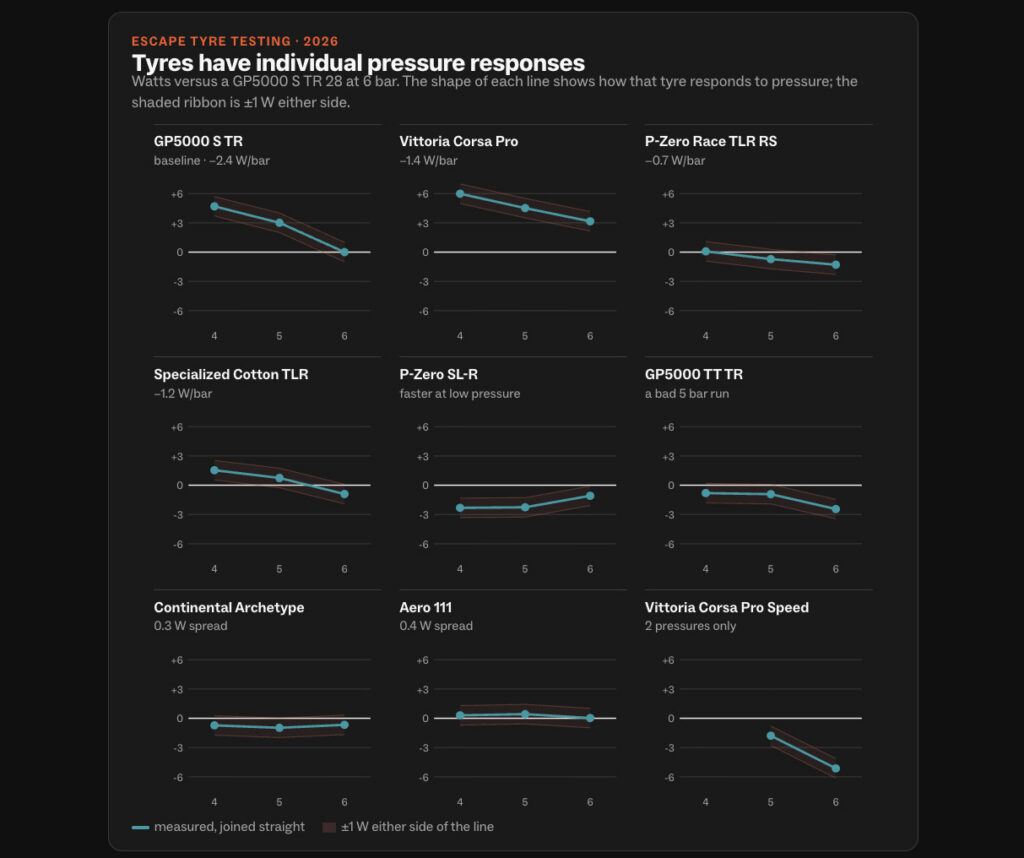
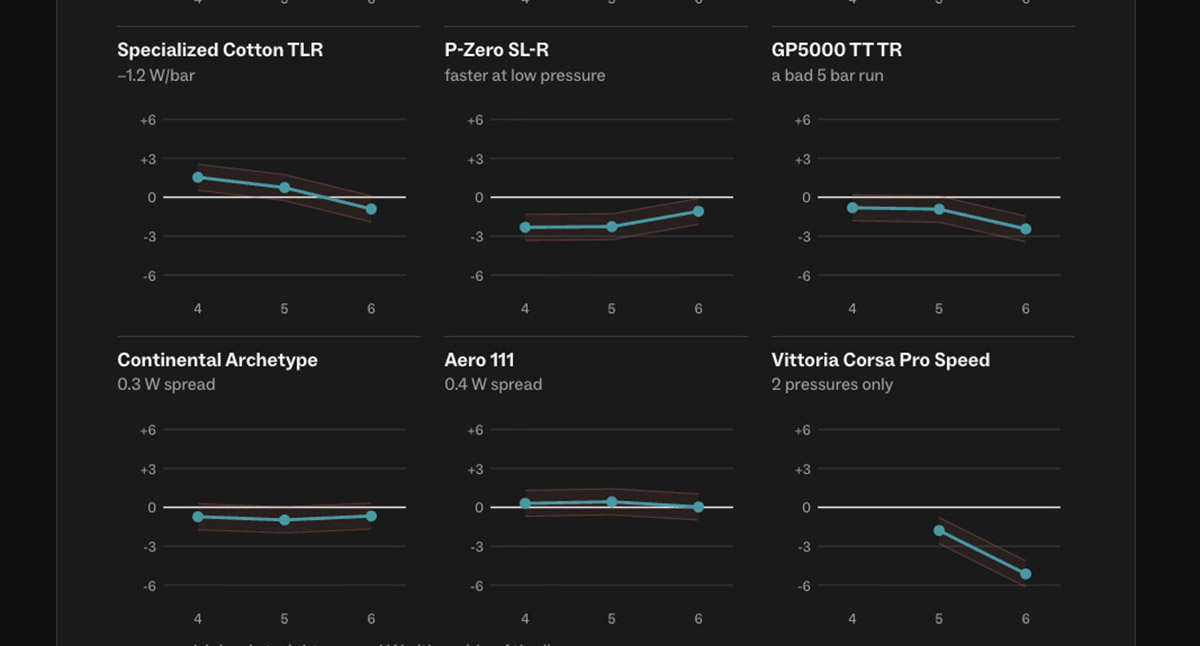
Beyond the leaderboard of which tires are fastest and which are (a little) slower, Ronan’s testing also showed how the tested tires behave at different pressures: He tested each tire at 4, 5 and 6 bar (58, 73 and 87 psi). At first sight, it seems like high pressure reduces the resistance of 4 tires by a few watts. However, the other 5 tires don’t roll faster when inflated harder.
These differences in tire behavior come as a surprise, since some of the tires use the same casings: the GP5000 S TR and the Aero 111. According to the manufacturer, the main difference between these two tires are scallops in the tread pattern on the Aero 111. (They are intended to reduce cross-wind instability with aero wheels.) Where it matters for tire deflection, these tires are identical, apart from 1 mm in width and 5 g in weight. Those differences are tiny, and you’d expect these two tires to behave similarly as pressure changes. Not so: The GP5000 S TR has 4.8 watt less resistance when you increase the pressure from 4 to 6 bar. However, the Aero 111 rolls at the same speed, no matter the pressure.
Ronan also measured the vibrations transmitted by the test tires at the different pressures. In this test, all tires behaved the same way: Going from 4 to 6 bar increased measured vibration by around 1.8 m/s². This suggests that all tires react similarly to changing tire pressures.
Ronan concluded that “the data here suggests most of us probably don’t need to obsess over chasing one supposedly perfect pressure number.” What if we’re preparing a race or an FKT? Should we inflate our tires according to the graphs above? Or are we just seeing the inevitable noise in the data.
Just looking at the nine graphs, the pressure responses do look random, with no clear reasons why some tires seem to get faster at higher pressure and others do not. This suggests that we’re seeing noise in the data, and not real differences in how these tires respond to increased tire pressures.
To look at this from a statistical perspective, I asked Mark Vande Kamp, who did all the statistics for our tire tests. (He’s got a Ph.D. with a minor in applied statistics.) Here is his response:
“We’d need the raw data to figure this out. An appropriate statistical analysis to evaluate whether we are really seeing different tire behavior would be a test of the interaction between: a) tire type; and b) the linear trend of tire pressure with watts. However, the statistical power of the research design is almost certainly too low to yield conclusive results. In other words, the reported differences between tires are almost certainly smaller than the (inevitable) noise in the data.
“Statistical power can be thought of as the likelihood that an experiment will detect a true difference between the tested conditions (in this case, differences between how tires respond to inflation pressure). Statistical power depends on three factors: 1) Effect size (bigger differences are easier to detect); 2) Sample size (lots of data points are better than a few); and 3) Variability (random variation makes it harder to detect true differences). The Escape Collective chart shows that the largest observed difference across the tire pressures was less than 5 watts (i.e., effects of pressure were relatively small). The description of the testing suggests that no more than four observations were recorded for each tire/pressure combination (i.e., there are few data points). And the earlier discussion of variability within the observations of the control tire concluded that the 95% confidence interval was approximately ±2 watts (a relatively large variation compared with the size of the observed differences).”
Four tires show no performance benefit of higher pressure at all. The other performance differences fall mostly within the 2-watt range that Ronan considers “closer to a tie.“
It’s also important to remember that Bicycle Quarterly’s testing also found no performance benefits of higher pressures for supple high-performance tires. Based on all this, we can conclude: With supple high-performance tires, there is no evidence that pumping them up harder will make them faster. That’s what we found 20 years ago, and it’s nice that those results now have been confirmed by other testers as well.
More Information:
- Escape Collective’s latest tire test
- Suspension Losses Explained: Why Vibrations Slow Us Down
- Our book The All-Road Bike Revolution details all the findings of our tire tests (and much more)
- Rene Herse tires: the original supple tires, based on the findings of real-road tire tests