

World Champions—What it Means for US Cycling
“I see you’re a cyclist,” said the white-haired gentleman with the Stetson Hat. “Our boy won that big race over in Europe. I read about it in Sports Illustrated“ He added: “Have a great ride!” With that, he got in his Cadillac and drove off. I had just arrived from Germany as a young college student and was sitting outside a gas station in Dripping Springs, deep in Texas Hill Country, sipping a huge Coke as I rehydrated on my first big ride to explore my new surroundings. “Our boy” was Greg LeMond, who had just won the Tour de France by eight seconds.
Last weekend, we celebrated the dual wins of Brandon McNulty in the elite race and Ashlin Barry in the U23 race. And let’s not forget the women, where Demi Vollering confirmed that she’s the best racer in the world right now. Slovakia’s Viktória Chladoňová won the U23 women. All these races were full of suspense and had worthy winners. For the U.S., they mark the first road race world champions after decades of drought.
That’s why I remembered my encounter in Texas all those years ago as we celebrated McNulty and Barry’s wins. LeMond’s victory had a profound impact on American cycling: It moved cycling from the fringes of society into the mainstream. When I raced my first-ever collegiate race a few weeks later at Texas A&M, the Category C field was huge, such was the influx of new cyclists. When I went to a small bike shop to buy some parts, the owner looked at my bike with its eclectic mix of components, and offered me a job on the spot when he found out that I had built it up myself. He urgently needed another mechanic to assemble the new bikes that were flying out the door.
Thirty-some years later, American cycling can use some help again. Those who already cycle continue to ride, but fewer children ride bikes, and fewer new cyclists enter the sport. E-bikes have captured the imagination of commuters and non-cyclists, and the idea of pedaling without assistance seems almost quaint to many. Bike sharing programs that were ubiquitous just a decade ago have all been replaced by e-scooters. Even though cycling is arguably safer than ever—more cyclists on the roads mean drivers are finally ‘seeing’ us—it’s seen as exceedingly dangerous. Cycling risks becoming like riding horses: What was once common is now a pastime of a few enthusiasts.
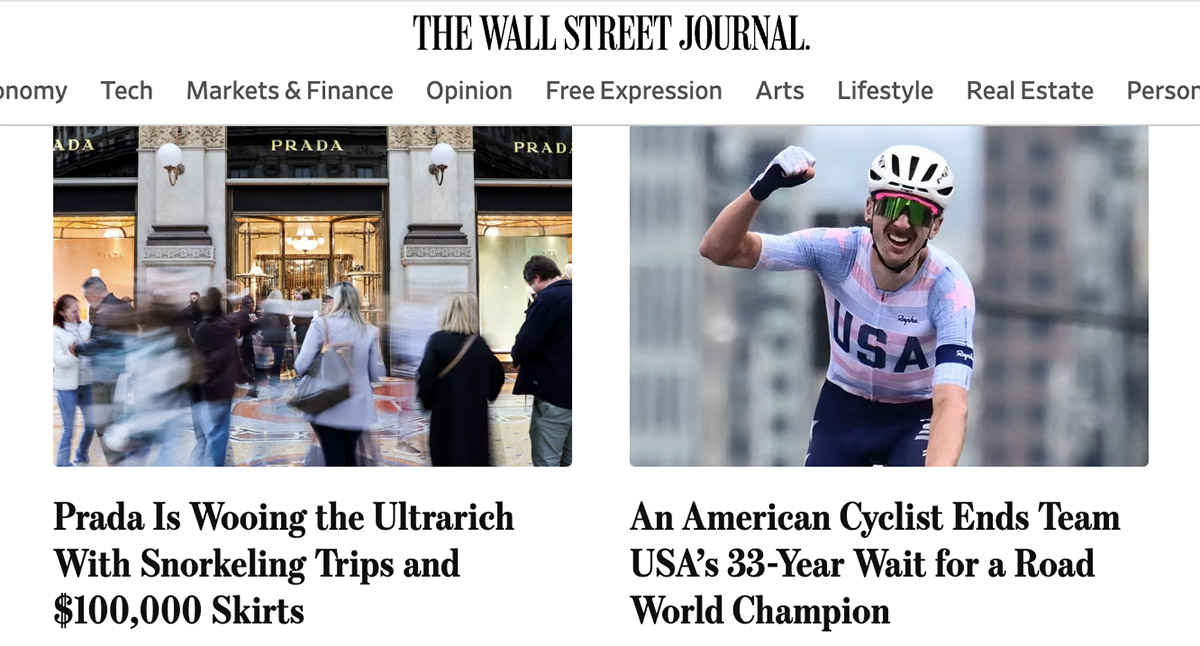
I don’t need to tell readers of the RH Journal how wonderful cycling is. Key for cycling’s future is showing non-cyclists the appeal of our sport. That’s why it’s so encouraging to see McNulty’s win on the front page of the Wall Street Journal. Not just one, but two world champions, both winning in fairy-tale break-aways, will bring cycling back into the consciousness of the general population—people like the white-haired Texas gentleman I met when I first came to this country. And that’s a wonderful thing in every way.
Further Reading: