


20 Years Ago: Start of Wide-Tire Revolution
Twenty years ago, in the Spring of 2006, we started testing tires. Almost by accident, we discovered that wide tires can be as fast as narrow rubber. What started as a small project—finding the best tires for long-distance rides—quickly spiraled into ground-breaking research that has revolutionized cycling in the two decades since. Back when we started, nobody—us included—would have predictedTour de France pros rolling on 30 mm tires, or gravel racers winning races on 55s. Virtually all road racers were on 23s, and ‘gravel grinders’ were discussing whether 28 mm was ‘too much tire’ for gravel. A few years later, a Japanese maker introduced the first ‘gravel’ tires: They came in 23, 26 and 28 mm widths! It’s hard to believe today, but that was the status quo in 2006.
Great discoveries rarely happen in a vacuum, but they build on previous research. If somebody claims to have made a brilliant discovery out of the blue, they may not be giving credit where credit is due. For example, Galileo Galilei discovered evidence that the earth was round when he built a telescope. Being able to see the planets in great detail, he noticed that the earth cast a shadow. This meant that the earth was between the sun and the planet… which was incompatible with the generally accepted idea that sun, planets and stars were suspended in the sky above a flat earth. He didn’t set out to disprove that the earth was flat—that was just the result of trying to get a better look at the sky.
Twenty years ago, rolling resistance wasn’t a big topic. We all ‘knew’ that aero was most important, and weight second. And we all thought that the main thing to reduce rolling resistance was to inflate our tires to maximum pressure.
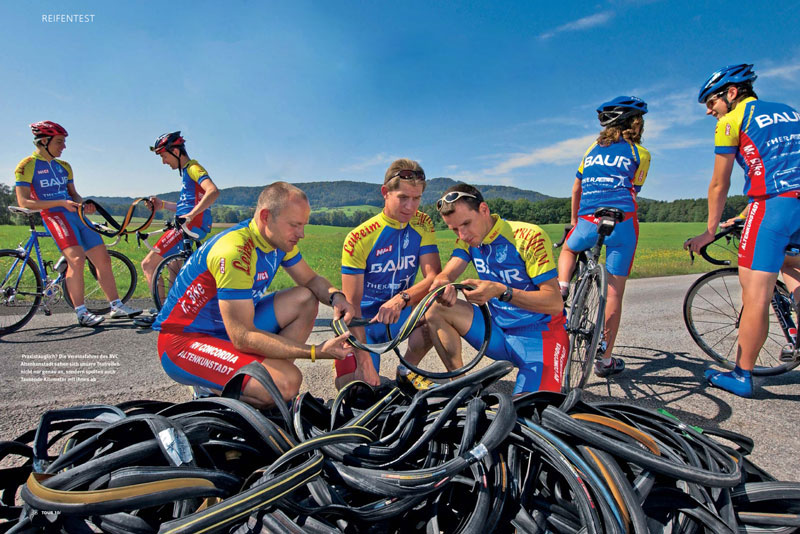
Then the German magazine TOUR published a huge tire test. They tested dozens of 23 mm road tires. They looked at puncture resistance, grip on dry and wet pavement, tire wear—and rolling resistance. (They tested on the steel drum of a well-known German tire maker.)
They found that the slowest tire, the Continental Grand Prix Attack, had almost twice (!) the rolling resistance of the fastest tire, a hand-made supple clincher. However, they echoed the prevailing wisdom and concluded that differences in rolling resistance were not really important: They amounted to just 34 seconds during a 10 km time trial.
I remember reading this and thinking: “Whoa! First, 34 seconds is easily the difference between winning and not even making it onto the podium. And second, as long-distance riders, we’re going much slower than the pro racers, so rolling resistance is going to be even more important for us.” We had already started to ride (slightly) wider tires (28 mm), but there were no tests for any of the tires we rode.
If the rolling resistance of racing tires could vary that much, how much greater were the potential savings for the wide tires we were riding—tires that didn’t always put performance first? How could we find out?
My riding partner Mark and I were straight out of college, and we didn’t have access to a drum testing machine. How about a roll-down test? Both of us had just spent the better part of a decade getting our PhDs. Mark’s was in social psychology with a minor in applied statistics. His specialty was evaluating real-world data. I had studied the history of climate change on Mount Rainier on a NASA fellowship, so I was used to getting reliable results under difficult conditions in the field. Scientific research was part of our DNA, and our combined skill set was tailor-made for designing a useful test of real-world tire performance.
We immediately realized that the big problem with a roll-down test would be to control what scientists call ‘noise’: wind, temperature, changes in rider position, and everything else that would affect how fast a bike rolls down a hill, beyond what we wanted to actually test: tires.
Minimizing noise was key. Most important was wind—we knew that we should test only when there was no wind. Even a little wind would mess up our results. We needed absolutely zero wind. From our randonneuring experience, we knew that, in Seattle, the time around sunrise is often completely calm. Next was temperature. On spring days, Seattle often sees very little change in temperature. Next was the rider position. Could our test rider keep the same position for test run after test run? The only way to find out was to try!
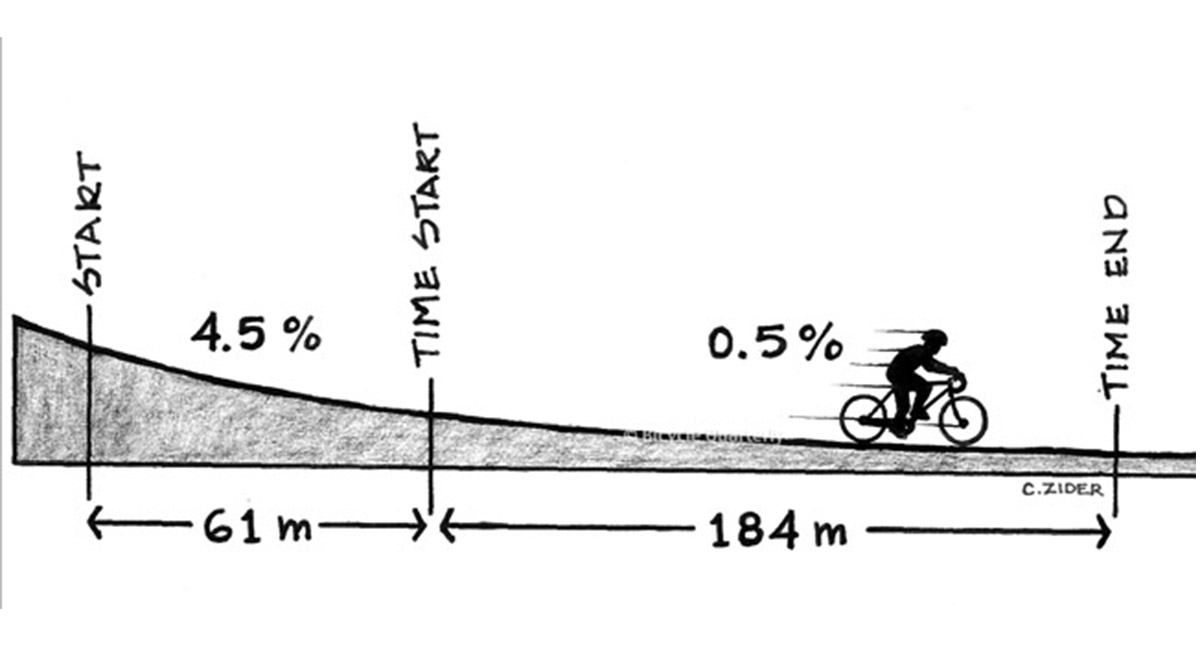
What kind of hill was best for our roll-down tests? We needed a hill that started steep and then leveled to a constant gradient. The bike had to get up to speed quickly, with no wobbles. We decided to use a ladder for the rider to hold onto, so they didn’t need to clip in, but could start rolling in the right position immediately. Mark knew an old soapbox derby track, which had exactly the right profile. An added advantage: There were no cars on this ‘road.’ The surface was rough, because it hadn’t been repaved in a long time, but there were no cracks or potholes. A uniform surface is essential, to get repeatable results. The rough asphalt was typical of typical for the backroads where we liked to ride.
The next step was a pilot test. I bought a set of the fastest tires in the TOUR test, plus a set of slow-ish tires. (I couldn’t find the slowest tires in the U.S.) We mounted the tires on our bikes and headed to the test hill just before sunrise on a Saturday morning. I rolled down the hill three times on the fast tires, then we swapped wheels, and I rolled down the hill three times on the medium-slow tires. Same bike, same rider, two different tires. Mark timed me. When we looked at the results, we saw that the three runs with each tire were within half a second—and the fast tires rolled about two seconds faster than the slow-ish ones. Our method had promise!
We then went for our normal Saturday ride. As we rolled through the bucolic Snoqualmie Valley, we plotted a big tire test. We decided that we didn’t just want to test tires, but figure out how tires work. We already had some doubts about the generally accepted status quo—that narrow tires were fastest. Jobst Brandt had pointed out that the contact patch of wider tires was shorter, which should make wider tires faster, at least in theory. The old French randonneurs I met during my historic research had talked about hand-made tires of the 1940s and 50s: “They were wide and supple—and so fast!” I had been riding old French randonneur bikes and tandems with 650B wheels and 38 mm-wide tires. I set many personal bests, even though the wide tires should have been slow. (Back then, I inflated the 38 mm tires to 75 psi. Neither Jobst nor we had any inkling that high pressures weren’t required for speed.)
We drew up a list of what we wanted to test: Different tire widths. Different pressures. Tires with thin and thick tread. Different tread patterns. Different wheel sizes. Different tubes. Over the next month, I bought and borrowed a huge number of tires. We got one tire, the Michelin Pro2 Race, in three widths: 20, 23 and 25 mm. I contributed the ‘wide’ 28 mm Rivendell Rolly-Polys that I’d been using as my go-to tire. We had the brand-new Rivendell 650B tires, one with a puncture-resistant belt, the other without. Mark wanted to test his 28 mm-wide Avocet Slicks and a set of 35 mm Paselas. We borrowed tires with small knobs. We had just started to import Grand Bois tires from Japan, and we had those in 700C and 650B. We even included a set of worn tires to see whether the thinner tread made them faster. And then we rode all those tires for 50 miles (80 km) to make sure they were broken in. It was a huge project, but we were young, and we had time.
Somehow, we already predicted that people might question whether we really could control the noise during our experiments, or whether we were just making up our results. So we asked Alex Wetmore, who was well-known in local cycling circles, but not yet a friend, to help with our testing: Alex was going to be a second timer of the roll-down runs, independent of my time keeping. Alex also contributed the test bike, an old Trek that had ample tire clearance. Mark was going to roll down the hill. Alex brought along his friend John Speare, who was visiting from Spokane, as an additional observer.
Then came the big day. The day before, I had gone out to sweep any loose rocks and gravel from the test hill: Hitting small rocks during one run and not the next might have affected our results. Then the four of us met at 5 a.m., just before sunrise, and started testing. We were lucky, the weather forecast was correct, and there was no wind at all. We kept checking the leaves of the trees surrounding our test track—if they moved at all, we stopped our testing, until they were calm again. (Later, some ‘experts’ tried to discredit our testing for being unscientific for this simple, but effective setup: Tree leaves are actually a more accurate indicator of still conditions than wind speed meters. In any case, our statistical analysis would have detected if wind influenced our results.)
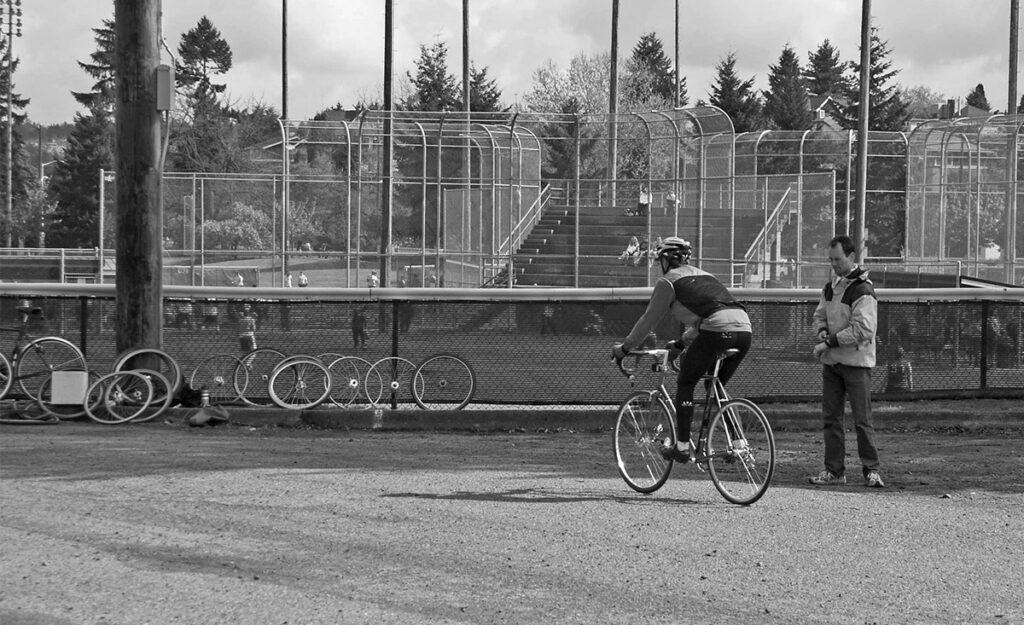
Mark rolled down the test track again and again. We switched tires and wheels, then repeated the tests. At 7:30 a.m., the leaves of the trees started moving ever so slightly. We waited for a while, but they didn’t stop: A light wind had sprung up. That ended our testing for the day.
It was disappointing, but we already had done 2.5 hours of testing, and we had first results. We had tested the same tires on multiple wheels and found that the results were identical. That meant we could ‘pre-mount’ tires in the future, and switch wheels, to get as much testing done as possible while conditions were good. Compared to our preliminary testing, refining the method had reduced the variability between runs of the same tires even further. We also found that the results of the two timers—Alex and me—were extremely consistent. That gave us additional confidence in our methods. The testing may not have looked very high-tech, but careful work is more important than flashy gizmos when it comes to doing science. The real test in science is how results hold up over time—and I think we can say in all modesty that we’ve passed that test.
After our first test session ended prematurely due to wind, we returned when the weather forecast looked promising again. For our next two test days, we were lucky: There was no wind all morning, and temperatures were constant, too. (We later realized that temperature had a huge influence on tire performance, something that also wasn’t generally known at the time.) We tested the same ‘reference tires’ first thing, in the middle, and at the end of each day. During those three days, we did more than 150 test runs. Mark had spent more than 20 hours rolling down (and riding up) the hill, his arms and upper body always in the same position. The riding wasn’t exciting, but the results were!
And those results were not at all what we expected! First, Mark did a statistical analysis to check which tires/pressures/setups were performing differently, and which were so close that we couldn’t tell which was faster. (There’s always a little noise—in our case about 2%.) The biggest surprise was that tires made a surprisingly large difference: On the fastest tires, the bike rolled 20% faster, compared to the slowest tires. That was huge! Imagine taking 10 hours off your time in Paris-Brest-Paris just by choosing different tires! Rolling resistance had a far greater effect on real-road speed than cyclists thought at the time.
A little disappointing at first: The tires we were running on our bikes were among the slowest. And the Grand Bois tires we were selling were also among the slower tires. That disappointment quickly turned into excitement: There was a lot of room for improvement!
The next surprise: Tire pressure did not have a meaningful effect on speed. Our tires rolled as fast at moderate pressures as they did when we inflated them to the max. That ran against everything we—and everybody else—believed. On the drum tests that everybody was using back then, high pressure, more than anything else, made tires fast. That’s why racers inflated their tires to 130 psi (9 bar). I ran Rolly-Poly tires because they were the 28 mm tires with the highest pressure rating: 120 psi (8.3 bar). Our tests showed that I could run my tires at 85 psi and not lose any speed.
Testing the three set of Michelin Pro2 Race tires, we found that wider tires had less resistance. The 25 mm rolled faster than the 23 mm, which faster than the 20 mm. The ultra-supple hand-made tire that had scored highest in the TOUR test was also fastest in our roll-downs, but other tires that scored well on the drum didn’t roll fast in the real world. Surprising was the result for the Mitsuboshi 650B tires I had run on the old French rando bikes: It was the fifth-fastest tire in our test, as fast as the narrow racing tires we tested.
We did a regression analysis to determine which factors were most important for making a tire fast. We found that a supple casing was the reason our fastest tires rolled so well. We also realized that many ‘performance’ tires rolled so slowly because they were designed to handle high pressures: They had strong casings that were also very stiff. And the wider the tire, the stronger the casing. Making a 28 mm tire to support 120 psi (8.3 bar) meant beefing up the casing to an extreme degree. We realized that, to be fast, wide tires should use supple casings. That would reduce their pressure rating, but we had found that this didn’t make them slower.
Why were our results so different from what other testers had found? Previous testing had been in the lab, on a steel drum, without a rider on the bike. We realized that the vibrations of riding on real roads slowed down the bike. That’s why high pressure didn’t make tires faster on real roads: They increased vibrations, which canceled out the benefit of less deformation as the tire rolled. Previous tests had measured only the tire’s deformation, but not the vibrations it transmitted.
Our finding—that high pressure wasn’t needed for speed—changed everything. Before, tires were either wide or fast. If you wanted to go fast, you put on narrow tires and inflated them to max pressure. Here’s why: With tires, you have to choose two of the following three:
- high pressure
- supple casing
- wide tire
In the same tire, you can have only two, not all three. When we thought that high pressure was essential to speed, we had to choose between a supple casing or a wide tire. That’s why the 24 mm hand-made clincher was so fast, both in our real-road tests and on TOUR’s drum: It had a supple casing. And since it was narrow, it could also handle high pressures. That’s also why my 28 mm Rolly-Polys were so slow: They were wide, so they ‘needed’ a stiff casing to support high pressure. Once we realized that high pressure wasn’t necessary to go fast, it opened the way for making tires that were wide and fast.
Being scientists, we sent our results to experts for review. Frank Berto, who had tested tires himself, provided input. Jim Papadopoulos asked for an elevation profile of our hill, to calculate whether the initial phase, before we started timing, affected our results. So I went out and spent a day surveying the hill in detail. Jim’s calculations confirmed: The bike always entered our timed section at the same speed. Andreas Oehler in Germany was another reviewer. These names may not be well-known today, but they were the bike tech experts at the time.
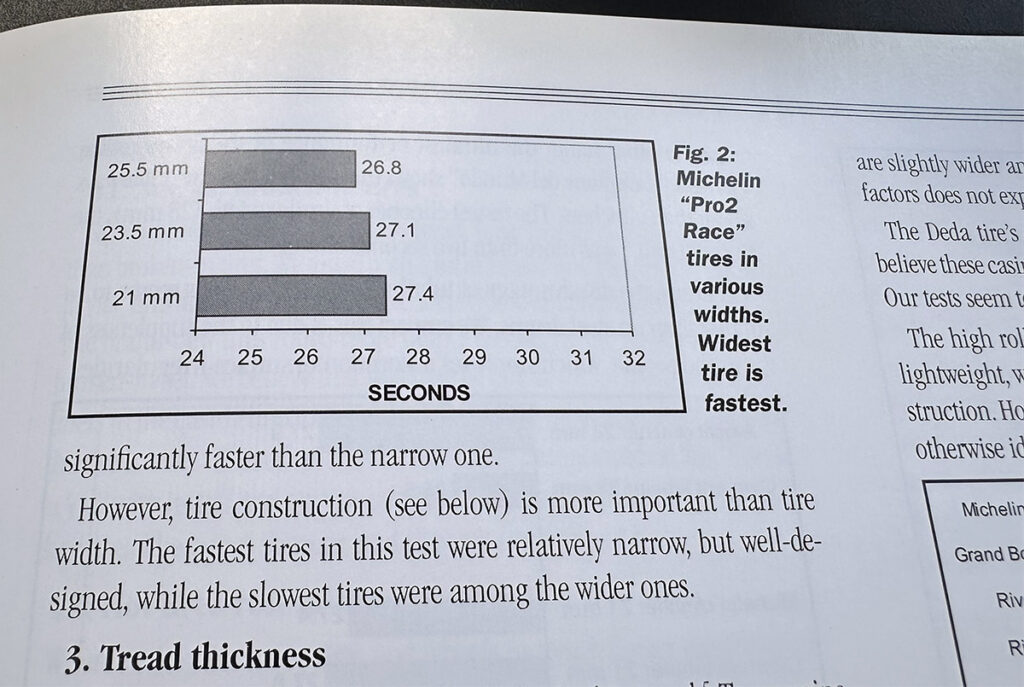
Then we wrote up our findings in Bicycle Quarterly 17, the Autumn 2006 edition. Our project had started as a simple test to find the fastest tire wide enough for long-distance riding. Instead, we had revolutionized our understanding of how tires work. The idea that high pressure was necessary for performance had become obsolete overnight. The implications were obvious, and they were huge. Our article concluded:
“Our findings point to a new direction for performance bicycles. For most cyclists, wide, supple tires at low pressures offer more speed, better comfort, increased versatility and improved safety than the currently favored narrow high-pressure tires. However, this type of wide, fast tire is not currently available. Hopefully, our results will persuade manufacturers to produce the ‘ultimate’ tires.”
That was a big statement from two young guys who weren’t even part of the bike industry. But we were confident in our results. We had checked and re-checked them. Our statistical analyses were sound. Experts had reviewed our work and approved of it. We were also putting our results to the test in the real world: We rode the fastest tires from our test in long-distance brevets, and our times improved by roughly the same amount as our tests predicted. Which was a lot—15% faster in a 1000 km brevet meant taking 6 hours (!) off my previous personal best.
We were young and naive. We thought that, now that we’d shown the way, tire makers would start developing wide, supple tires. Of course, we now know that the bike industry wasn’t interested, for many reasons. After spending a few years pushing others to make the tires we envisioned, we finally made them ourselves. That’s how the Rene Herse Cycles tire program started. It took more than a decade until our findings became accepted in the mainstream. In the next part of this story, we’ll look at what it took to get there.
Further Reading:
- Bicycle Quarterly 17 includes the report of our tire tests (sorry, out-of-print)
- Our book The All-Road Bike Revolution details all the findings of our tire tests (and much more)