



Why We Don’t Use AI
Artificial Intelligence (AI) is changing the world. We don’t know yet whether it’ll make many of our jobs obsolete, but we can already see the results every day, when we scroll through news stories or open our inbox. AI has made it easier than ever to generate ‘content.’ If you want to turn a random press release into a news story, or if you need to write an email to promote a new product or a discount, AI has you covered.

Sometimes, that goes spectacularly wrong, like REI’s Instagram post that featured a bike with both rim and disc brakes, and two sets of handlebars: flat bars at the front and drop bars under the saddle. That made the news, because it was so hilarious.
Most of the time, AI-generated output is perfectly credible. Photos no longer show six fingers on cyclists’ hands, and texts match what we already know (or at least believe). Most AI-generated ‘content’ blends in perfectly with other images and stories. It’s middle-of-the-road, generic and (usually) non-offensive.
That’s how the infamous REI ad came about: To broaden the ad’s appeal, AI made sure to include rim and disc brakes, plus drop and flat bars. Trying to be as generic as possible, the image became nonsensical.
At Rene Herse Cycles and Bicycle Quarterly, we don’t use AI. It’s not that we’re concerned about AI creating nonsense—that will surely be fixed in future iterations of the software. (Already, AI knows better than to appeal to both female and male customers by giving the cyclist two heads.)
The reason we don’t use AI is simple: It’s not good at coming up with new ideas and original content. AI, by definition, reflects what it’s been ‘trained’ on. Sometimes, it can create new associations—usually when it’s ‘hallucinating’ (i.e., making up stuff). Most of the time, it represents conventional wisdom.

Conventional wisdom is not our speciality. It’s not that we are renegades who delight in smashing convention, but we also aren’t interested in copying what others do. We figure that big companies and mainstream media have conventional wisdom covered.
Instead, we follow the science, which can lead to amazing discoveries. Turns out there’s plenty that conventional wisdom is overlooking. Things like suspension losses that make wide tires as fast as narrow rubber. Noise-canceling tread patterns for knobby tires. Even narrow handlebars for better aero were overlooked for many years—we discovered this way back in 2007, when we tested ‘real-world’ bikes in the wind tunnel. Back then, a feature in Bicycle Times called us the ‘most influential bike magazine you’ve never heard of.’
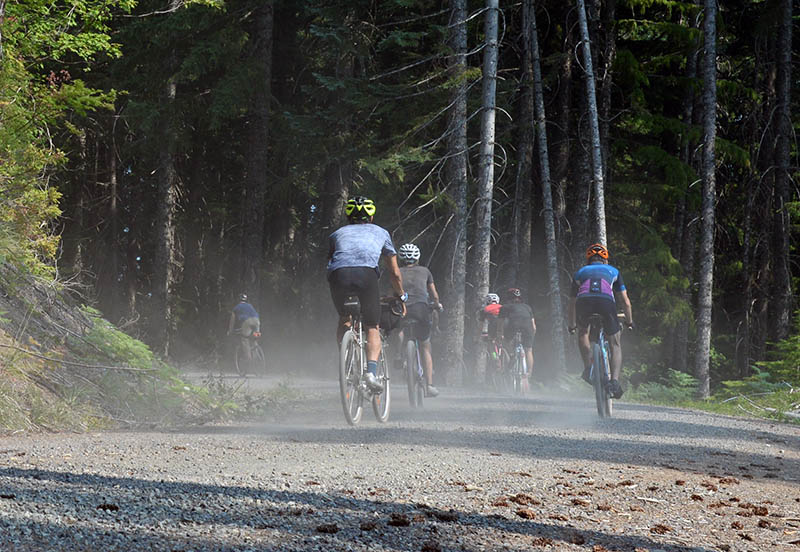
Since then, we’ve been busy converting that research into products that improve everybody’s cycling experience. And we’ve been riding them in races and adventures to field-test our research. (In the photo above, Mark passes a surprised racer on a more conventional bike during the 2022 Unbound XL.) We really have no time and interest to do things that others are already doing. And yet AI would always steer us into that direction.

Take our latest tires, for example: If we asked AI how to create a ‘perfect’ semi-slick, it would come up with a generic tire that’s a mashup of all popular models. Such a tire wouldn’t offer anything different from others on the market. We only started developing semi-slicks when we realized that we could make tires that eliminate all the compromises inherent in the ‘normal’ way of making semi-slicks.
Rather than following conventional wisdom, we started with a clean sheet of paper and analyzed the forces on each tread block. That’s why our semi-slicks look different from others. The first row of knobs is anchored on the slick center section, and the side knobs are much larger than you’ll find on most ‘fast gravel’ tires. Both features increase the stiffness of the knobs, so these tires have more traction and roll faster. It all makes sense, but you have to think outside the box to come up with new ideas like this. That’s not something AI is good at.
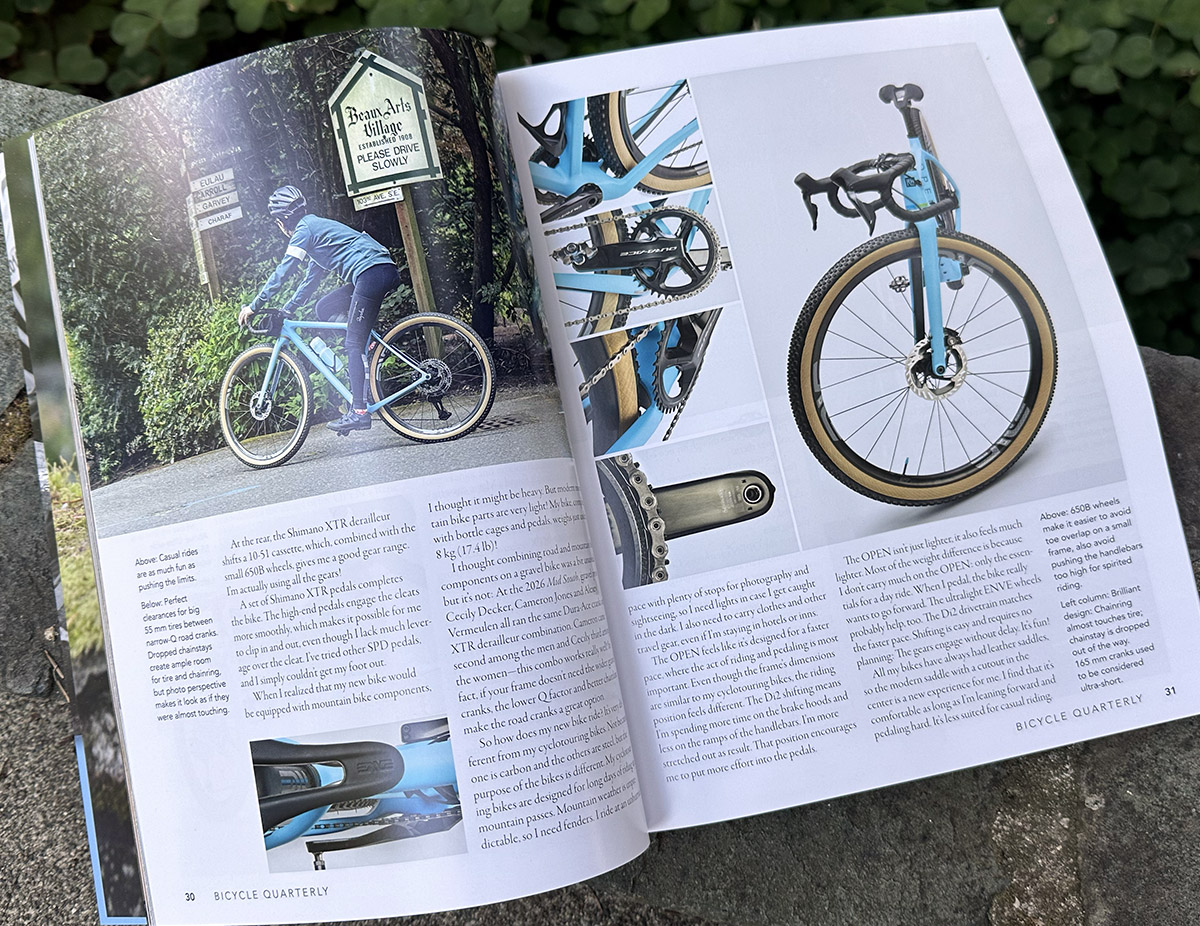
It’s the same with the articles you read here in the RH Journal and in Bicycle Quarterly. There’s no need to write yet another story how Pogačar won yet another Tour de France stage. Or how the latest aero wheels give one team or the other an advantage (which then somehow never materializes on the road). Others already cover these topics, and they’re doing an excellent job.
When we write about the Tour, it’s to provide information you won’t find anywhere else. AI cannot generate a story how tire sponsorship in the Tour is really about car tires. Or interview Enve’s Jake Pantone to find out why Pogačar’s wheels have gone from hookless back to hooks. It’s the same with our technical articles, whether it’s about tire pressure or why wet-lubed chains aren’t ideal for gravel riding. When you come to the RH Journal or pick up Bicycle Quarterly, you’re looking for tech, adventures and history that you won’t find anywhere else. Of course, that’s also why they aren’t part of AI’s ‘training.’
We also don’t use AI to edit our texts. At first sight, that’s something where AI should excel. However, we’ve found that AI-edited texts often sound generic—as you’d expect, considering that AI is an amalgamation of everything it’s been trained on. We choose our words carefully, and most of AI’s ‘edits’ change the meaning in small, but important, ways from what we intended. Beyond that, we feel that stories should have personality, not just in their contents, but also in their style. (The same applies to bicycles, by the way.) Once in a while, we may overlook a typo that AI would have caught, but we prefer that, over texts that have been smoothed until they indistinguishable from hundreds or thousands of other stories. (AI probably wouldn’t illustrate a cycling article with a photo of tomatoes, either.)

Great writing reminds me of the heirloom tomatoes Natsuko and I buy at the farmer’s market: They aren’t perfectly round and uniformly colored, but that makes them more interesting to look at. Most importantly, they are full of flavor, and each variety tastes distinctly different. Eating them is a memorable experience. Similarly, it makes my day when I meet cyclists on the road, and they talk about a story we’ve published, or a ride they’ve done on Rene Herse tires or components. Creating memorable experiences is what our job is all about.
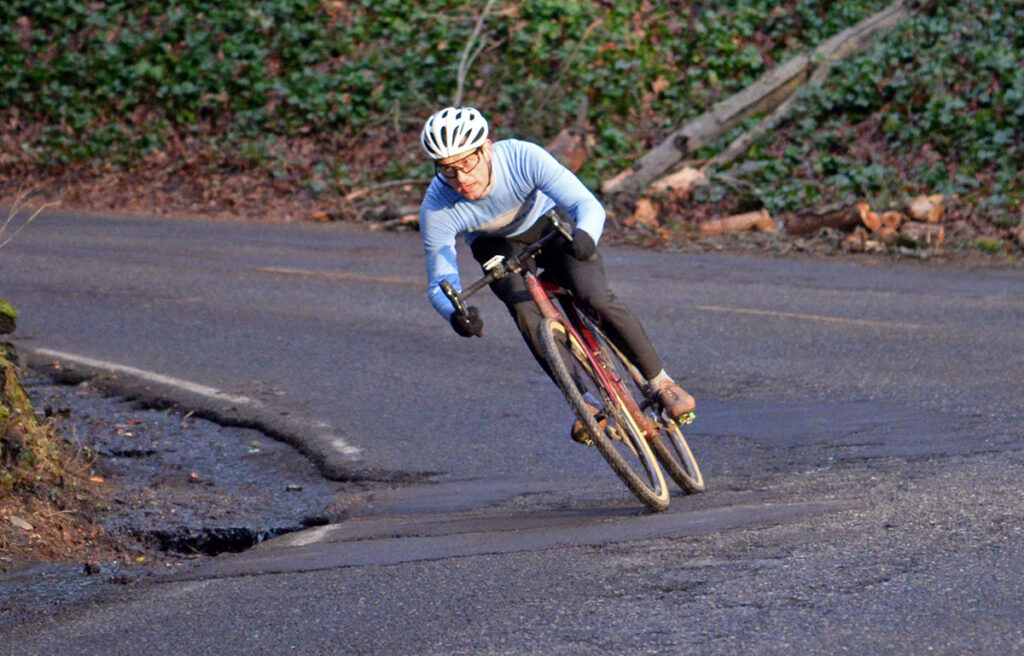
We also don’t use AI to edit (or create) photos. To us, that’s about honesty: Our photos show our products in action, or they show scenes from rides, races and adventures. If we alter them, they no longer document what we want to show. If we need an image and there is no photo, we’d rather commission original, hand-painted artwork than use a fake image.

Another area where AI is quickly taking over is customer service. For big companies, that may make sense. If a customer wants to know where their package is, but can’t figure out how to look up the tracking, AI can do that for them. For the rest of us, we usually contact customer service only after we’ve already exhausted the obvious options. Our questions are not easy to answer. That’s when the ‘AI Assistant’ is often no help at all. And then it’s almost impossible to get in touch with a human who can actually solve the problem, rather than read from a script that doesn’t apply to our situation.
At Rene Herse Cycles, we’ve found that our customers—you—know what you are doing. You’ve already checked the obvious things like our FAQ and product specs. When you contact us about something you ordered, we want to spare you the frustration: Your request is handled from the beginning by humans. And they aren’t in a call center somewhere, but in our office, here in Seattle—and they are cyclists and intimately familiar with our products. Because we know that our customers rarely ask ‘generic’ question that AI could answer…
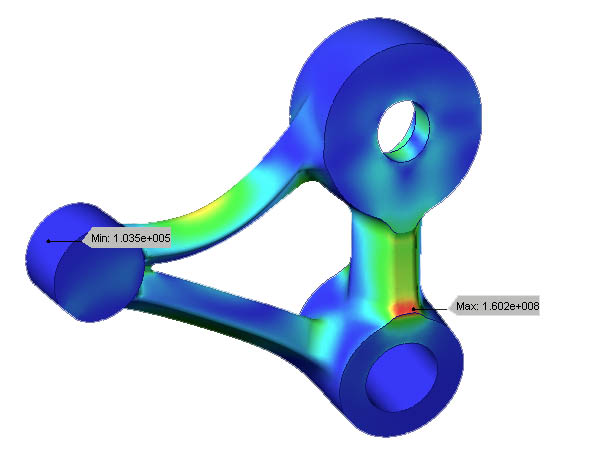
We aren’t luddites who write our stories on manual typewriters. We use technology where it improves the experience of our customers—you. We were one of the first cycling companies to communicate with our customers via our email newsletter and the RH Journal. Desktop publishing is key to making the photos and text in Bicycle Quarterly so beautiful. Computer Aided Design (CAD) helps us make components that are stronger, lighter and more durable than they would be otherwise. Technology allows us to create tires with noise canceling tread patterns and other innovations. We use systems for our customer service that automatically pull up your order and previous messages, so our (human) employees don’t need to ask you for the same information twice.
Lately, all these software programs have been inviting us to “Explore how AI can automate your processes!” That’s when we say “No Thanks” and click on ‘Cancel.’ And then we write our stories, design our products, and answer our customer’s messages ourselves, the old-fashioned way.
Perhaps our position is best summarized like this: We aren’t against Artificial Intelligence, we just don’t find it useful for what we do. Because in the end, it’s all about creating memorable experiences.
More Information:
- Bicycle Quarterly, the (AI-free) magazine about the Passion of Cycling