


The Science: Mtb Tires for Gravel
“XC mountain bike tires are the hottest gravel trend!” You’ve probably seen the headlines. Ever since Lachlan Morton won the 2024 Unbound 200 with a 50 mm tire on the front—the largest he could fit on his bike—there’s been a trend toward running mountain bike tires on rough gravel.
BikeRadar.com recently reported: “Elite gravel racers are increasingly shunning dedicated gravel tyres in favour of wider rubber designed for mountain bikes.” This isn’t just about the additional width—and associated lower pressure—which make the tire roll better over rough surfaces. There is a second, long-neglected benefit: Wide tires are less likely to puncture, which allows running a thinner, lighter and more supple casing—which rolls faster and is lighter than the thicker, stronger and stiffer casing you’d need on the same terrain with a narrower tires and higher pressure.

Quoting Dylan Johnson (above), a professional gravel racer, coach and Youtuber, the BikeRadar article explains: “XC mountain bike tyres can be even more efficient than the fastest gravel tyres because they can be made with thinner casings. This, Johnson says, is because the increased volume of XC tyres means they don’t need as much casing material or tread thickness to ward off punctures. In turn, this enables them to be more flexible and to conform to imperfections in the trail surface more easily, lowering their rolling resistance.”
If you think this sounds straight out of a past edition of Bicycle Quarterly, you aren’t the only one. We’ve often talked about the ‘win-win-win’ situation of wide, supple tires. The 3 wins are:
- Comfort: lower pressure reduces vibrations
- Speed: fewer vibrations mean more speed
- Durability: lower pressure reduces the tension of the casing, making it harder to cut
There’s a fourth ‘win,’ as alluded by Johnson: Thanks to the extra durability of wide tires, you can use more supple casings without undue puncture risk. That brings even more speed and comfort—the start of a virtuous cycle.
What about the aerodynamics of wider tires? Johnson’s testing confirms the results of Bicycle Quarterly’s wind tunnel tests: Up to a certain point, wider tires aren’t significantly less aero. In fact, Dylan Johnson found that a wider tire can be more aero, depending on the bike.
Bikeradar notes that not all racers are on board. Some racers point to the greater weight of wide mountain bike tires as a disadvantage during long climbs. And since attacks often are made on climbs, that’s important for racers.

Let’s look at the science. There is no doubt that wider tires roll faster on rough surfaces. This effect is due to their lower pressure, which allows the tire to absorb surface irregularities without lifting bike and rider. This has been known for over a decade—at least since Bicycle Quarterly’s groundbreaking 2009 study of suspension losses on rumble strips. (As an aside, helmet fashion has changed, hasn’t it?)
To quantify the effect of tire width and pressure on different surfaces, we rode a bike with a power meter on a newly paved, ultra-smooth road surface to get a baseline. Next we rode on rumble strips right next to the smooth surface.
We chose rumble strips because they are all identical. That way, we get repeatable results. On gravel or cobblestones, we might hit big bumps during one run and then ride on a slightly smoother line the next time. Plus, the rumble strips are right next to the smooth surface. That means we can isolate one variable: surface roughness. Everything else remains the same from one run to the next: bike, rider, temperature, wind or lack thereof (we tested on a completely calm day)…
We ran each setup six times, alternating between rough and smooth: Rough-smooth-rough-smooth-rough-smooth. Then we averaged the results for each surface. (We did a statistical analysis to make sure that we were seeing actual differences in performance, not noise in the data.)
It’s been over a decade since we did this study and discovered how important suspension losses are. That’s why the tires we tested are not current models any longer. They are also narrower than what we’d run today. Back then, a 38 mm tire was considered huge. Racers were still on 23s and everybody else on 28s or 32s. And since Rene Herse wasn’t making tires yet, we had to do our testing with tires available at the time. Even though the actual tire models have changed, the conclusions about tire width and pressure remain valid.
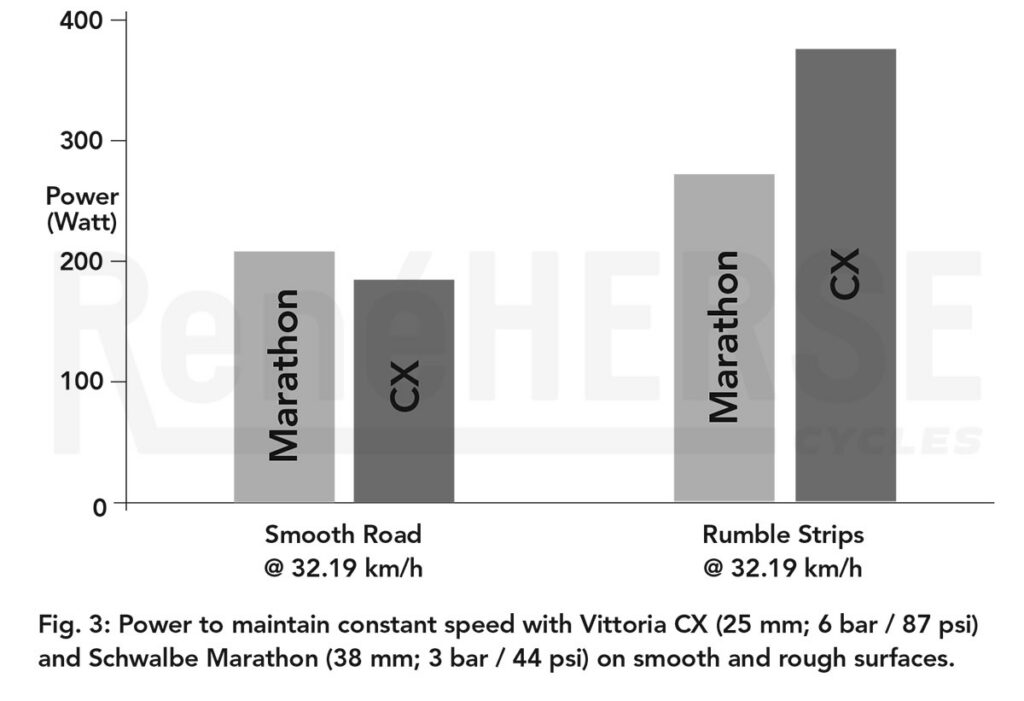
Above you see a comparison between a 25 mm-wide race tire (Vittoria CX) and a 38 mm-wide city bike tire (Schwalbe Marathon). These two are totally different tires, but they make a useful comparison. The CX weighs a third of the Marathon (240 vs 720 g), and we ran it at double the pressure (87 psi vs 44 psi / 6 bar vs 3 bar).
On the smooth road, the CX was faster. You’d expect that from a race tire! The Marathon required 13% more power to pedal at the same speed. That’s a difference of 24 watts at 20 mph (32.19 km/h).
The advantage of the race-bred CX turned into a negative on the rumble strips. On the rough surface, the narrow, hard racing tire required almost twice as much power (+96%) as it did on the smooth road. However, the wide and (relatively) soft Marathon needed only a moderate increase in power power to ride at the same speed. In fact, the city bike tire was much more efficient than the race tire on the rumble strips: 273 watts (Marathon) vs 376 watts (CX). That’s a 103 watt difference!
In other words, the advantage of the wide tire on the rough (103 W) is much greater than its disadvantage on the smooth (24 W). Here’s why:
On the smooth surface, the CX played its supple casing: Hysteretic losses—energy lost as the tire deforms with each revolution—was much lower compared to the Marathon with its ultra-stiff casing and multiple puncture-resistant layers. On the rumble strips, the Marathon benefited from its lower pressure (3 bar vs. 6 bar), which greatly reduced the suspension losses. This also affected rider comfort. Whereas riding across the rumble strips on the Vittoria CX was painful, it was only somewhat uncomfortable on the Marathons.
Remember that we’re comparing a top-tier 25 mm racing tire (CX) with a reinforced, ultra-tough 38 mm city tire (Marathon). What if we use an ultra-wide racing tire instead? Back in 2009, that option didn’t exist: The widest racing tires measured 25 mm. In our test report, we postulated: “Using the supple casing of the race tire on a tire with the width of the city bike tire would combine the best features of both. Such a tire would roll as fast as the race tire on smooth pavement. On rough roads, it would run at the same low pressure as the city bike tire, and its supple casing would improve performance and comfort even beyond that of the Marathon.” (We bolded the first sentence, since it was such a far-out idea back then.)
By then, we had already realized that simply publishing ground-breaking research wasn’t going to persuade the industry to make the tires we wanted, so we created them ourselves. In 2014, we introduced the first Rene Herse tires, and the following year we added 55 mm-wide tires. All Rene Herse tires used the same ultra-supple casings as the best racing tires. That was revolutionary back then. In fact, as we’ll see further down, it’s still revolutionary today.
Back to the science: Did our ideas really work? Theory is worth only so much, until it is backed up by real-world testing…
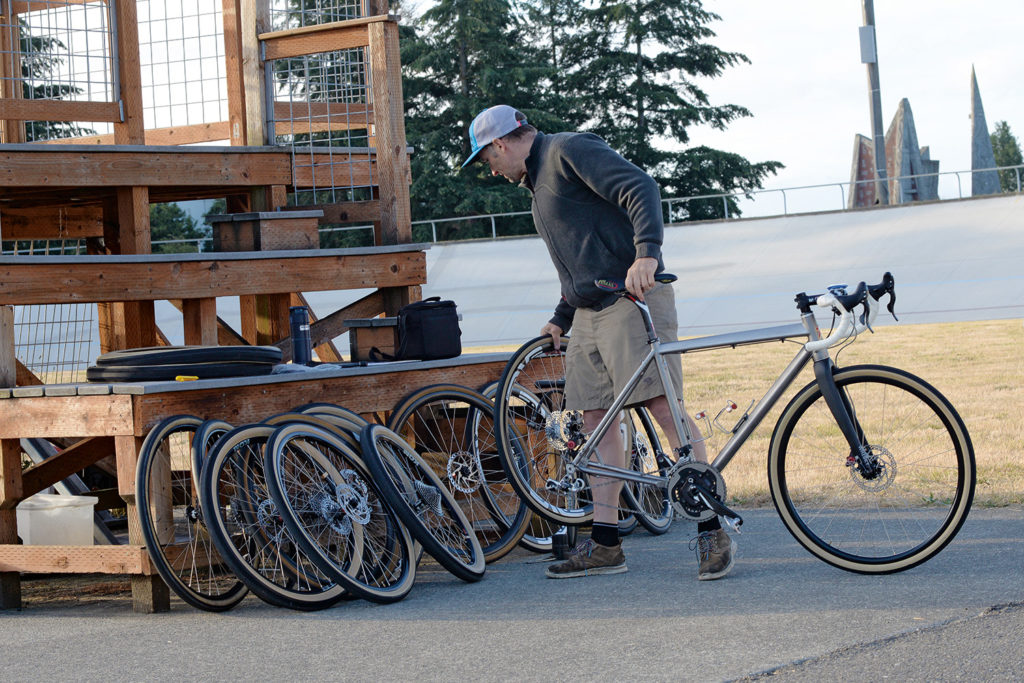
Our rumble strip tests had already shown that a wider tire—no matter the casing—is faster on rough surfaces. Would a supple casing eliminate the wide city bike tire’s handicap on smooth pavement?
We tested that on a smooth velodrome track. Below are the results:
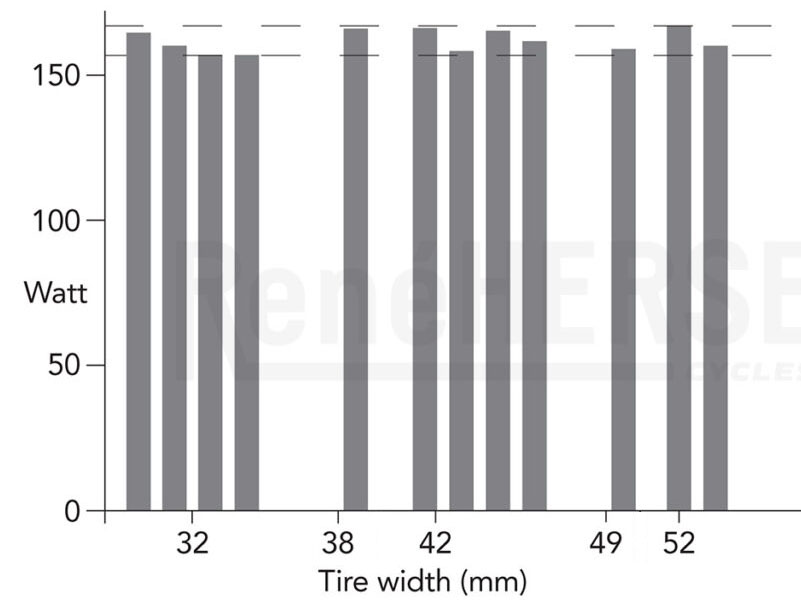
Each bar represents one set of tires, from 26 to 54 mm (actual widths), all with Extralight casings. These tires are as close to identical as possible, except for their widths. That way, we can isolate the effect of tire width on smooth-road performance.
As with all testing, there’s a little noise in the data (± 4.7 watts), but the differences are not statistically significant. Most of all, there is no trend suggesting that wider tires are slower (or faster).
Even if we take the data at face value, the 49 and 54 mm tires are among the fastest. And since these are real-road speeds, this also factors in aerodynamics. Just like Dylan Johnson suggested, it’s not a foregone conclusion that wider tires are less aero.
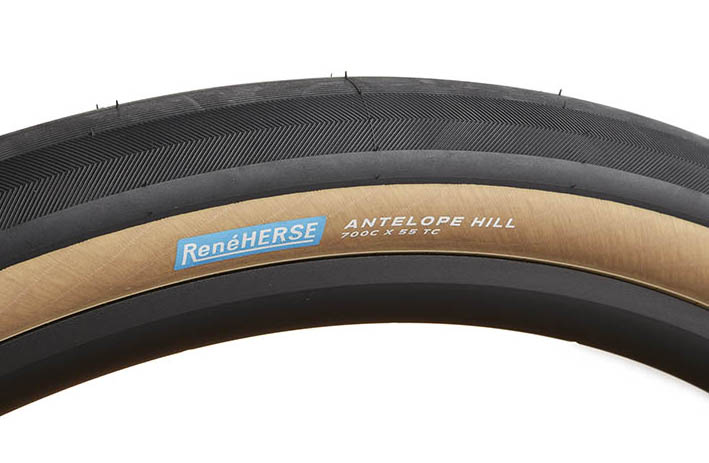
That leaves the weight disadvantage of wider tires. This is where the supple casings come into play—they aren’t just faster and more comfortable, but also lighter. Rene Herse Antelope Hill Extralights are 55 mm wide, yet they weigh just 485 g—less than 45 mm ‘gravel race’ tires like the Pirelli Cinturato Gravel H (530 g) or the Schwalbe G-One RS Pro (530 g). If you need more sidewall protection, the Endurance casing offers better puncture protection and more volume than those gravel tires, with only a slight weight penalty (550 g).
That’s a key feature of Rene Herse tires: You don’t have to choose between width and durability. We offer all our tires with a choice of casings. And as Dylan Johnson pointed out, the wider you go, the more you can ride a supple casing without risking flats or sidewall cuts. You wouldn’t race a 44 mm Extralight at Unbound, but you might consider a 55 mm Extralight.

Does that really work in practice? When I’m riding in a field of the world’s fastest pros during the opening miles of Unbound XL, I need all the help I can get. (I don’t have the genetics of a pro, and running a company means I have far fewer training miles. And let’s not even talk about the age difference…)
The fact that I was on 55 mm Extralights while the pros were on 40-45 mm ‘gravel’ tires helps explain why I could keep up for an hour and 19.3 miles (31.1 km) over the rough and steep gravel of the Flint Hills. (Above, you see me with boxy bag, and eventual winner Sebastian Breuer on the far right and second-place finisher Logan Kasper on the far left.)
After that initial hour, my legs reminded me that there’s no substitute for power, while my brain told me that we still had a looong way to go—330 miles. I let the pros go and settled into my own ride…

Jenna Rinehart (front) is a pro, and she’s been racing at the top level on 48 mm Poteau Mountain semi-slicks. She also prefers the Extralight casing for all but the roughest courses. A lightweight rider like Jenna runs lower pressures than the rest of us, so she doesn’t need to go all the way to 55 mm to get the benefits of wide tires.

Tall pro racers like Ted King or Brennan Wertz (above), who put out 500+ watts and ride in a peloton where they don’t even see rocks before hitting them, the Endurance and Endurance Plus casing are obviously better choices. That’s why we offer our tires with a choice of four casings.

The Bikeradar article mentions that “there’s a change coming.” What’s that change? They predict that other companies will introduce ultra-wide gravel tires in the future, which will be better suited to gravel. The article concludes with: “Are XC mountain bike tyres the future of gravel? Maybe not, but I think gravel-specific tyres in similar sizes are.”
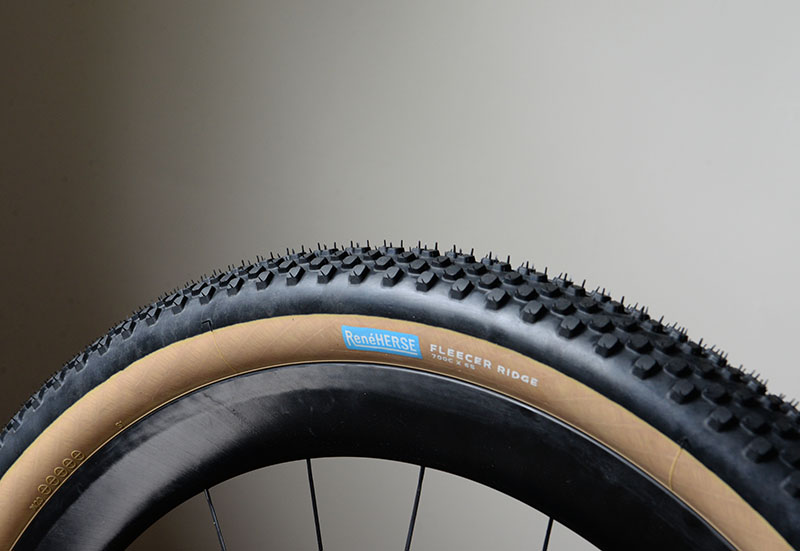
Well, there’s no need to wait: The Rene Herse 700C x 55 Antelope Hills have been available for 11 years now, and their knobby cousins, the 700C x 55 Fleecer Ridge, for 6 years.
The future has already arrived!
More Information:
- Bikeradar article why gravel pros use mountain bike tires
- Rene Herse All-Road and Gravel Tires
- Our book The All-Road Bike Revolution summarizes all our research in a fun, easy-to-read format.
Photo credits: Marc Arjol Rodriguez / Velophoto.tx (Unbound photos); Dylan Johnson (Dylan Johnson photo); Clare Paniccia / @nopressurejustbikes (Jenna Rinehart photo); Jim Merithew / @tinyblackbox (Brennan Wertz photo)