


The Science: Why 32-inch wheels may NOT be faster
Summary: Carefully controlled tests have shown that larger wheels generally don’t roll faster—neither on pavement, nor on gravel, nor on cobblestones. The concept of better ‘roll-over’ applies to solid wheels, but not to pneumatic tires that absorb road irregularities, rather than lifting bike-and-rider over them. Wheel size doesn’t really matter as long as the bumps are small enough that they can be absorbed by the tire. These results don’t apply to mountain bikes, which encounter larger obstacles.
Introduction: When 32-inch wheels suddenly became a big thing recently, many of us thought: “Why has it taken so long?” After all, it’s been more than a decade since 29ers replaced smaller wheels on mountain bikes. If 29″ wheels are so much faster, the obvious next step is to try even larger wheels. Imagine winning every city-line sprint after switching to a 53-tooth chainring—it would be obvious to try a 54 and see if that’s even better! Why did bike makers stop at 29″/700C wheels for so long?
I guess this illustrates the golden rule of product design: “Always leave room for upgrades.” In fact, 30″ wheels were teased briefly in 2023 by an OEM brand, but no bike maker was ready to commit at that time. Why not? Back then, warehouses were full of excess inventory left over from the pandemic-era bike boom. Bike makers needed to sell those 29″ / 700C bikes first. A ‘new-and-improved’ wheel size would have made all those bikes obsolete and unsellable.
Now all that excess inventory has finally been sold. That creates a new problem: Many riders have almost-new bikes that will last a long time. Sales are slow. The industry has come up with an obvious solution: Get these riders to upgrade to something new and better! That’s why there’s so much buzz around 32″ wheels. If it was for purely technical reasons, we would have expected this ‘logical next step’ way back in the early 2010s, shortly after 29ers became popular…
When you listen to the mainstream media, there seems to be little doubt: 32-inch wheels are said to offer significant performance benefits. However, let’s not forget that these are the people who told us that that narrow tires are fastest—long after the science was clear: Supple, wide tires roll just as fast.
What’s remarkable in all the excitement about 32-inch wheels: There is a total absence of data to back up claims of superior performance of larger wheels. By ‘total’ I mean zero—none at all. In fact, all the data shows no performance benefits, at least for road, all-road and gravel riding. (We haven’t done any testing on mountain bikes, where other factors may be at play.)
Before we go any further, I’d like to mention: From a business perspective, Rene Herse Cycles doesn’t really care one way or the other. We already offer 26-inch, 27.5-inch (650B) and 29-inch (700C) tires. If 32-inch wheels become popular, we’ll have no trouble making tires for them, too.
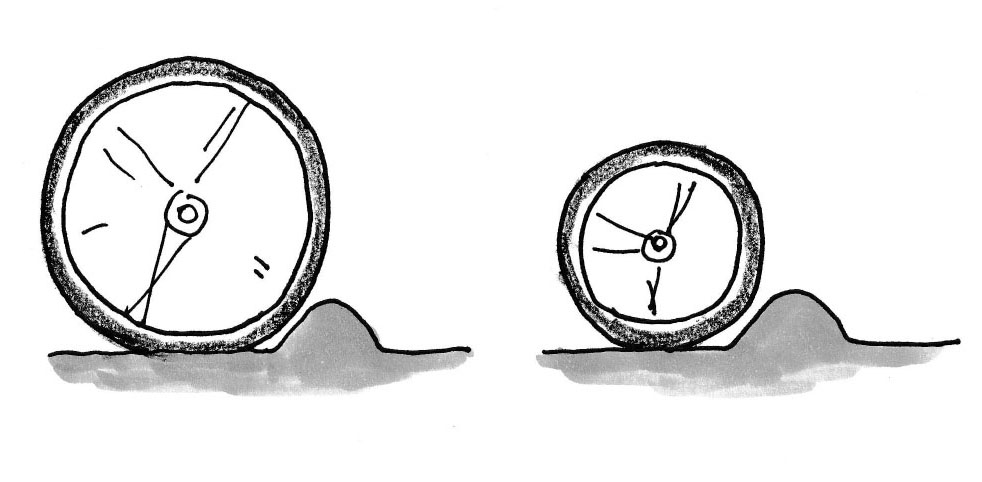
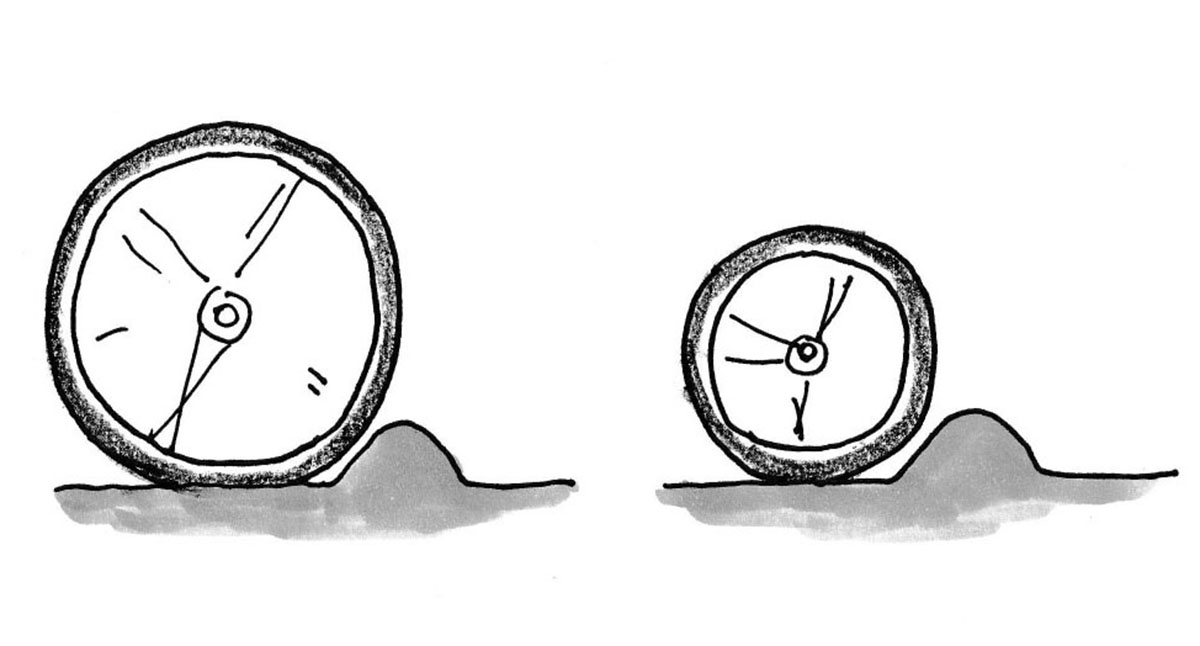
The Science: Let’s look at the science. You’ve probably heard the claims: Larger wheels have better ‘roll-over.’ At first sight, this seems to make sense: For a bump of a given size, the larger wheel will have an easier time rolling over it. We can go into details of approach angle and so on, but the illustration above shows it clearly: A bump of a given size will be a greater obstacle to a small wheel than to a large wheel. And a wheel that rolls better over bumps will have less resistance—especially on gravel and cobblestones. This presented as a no-brainer—so obvious that it’s not necessary to prove it. But that’s not how science works.
In the absence of science, people have come up with all kinds of explanations. One bike maker invoked shopping cart wheels: If those were bigger, they’d roll better through the parking lot. That’s true, but it actually shows why large bicycle wheels do not roll faster: Shopping carts don’t have pneumatic tires. Shopping cart wheels are just solid discs.
Bicycle tires aren’t solid. They are filled with air. And that changes everything.
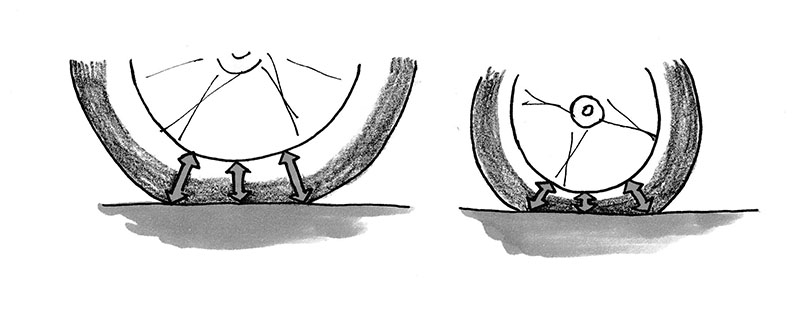
Pneumatic tires are not round discs—they are flat at the bottom. The tire deforms where it touches the road.
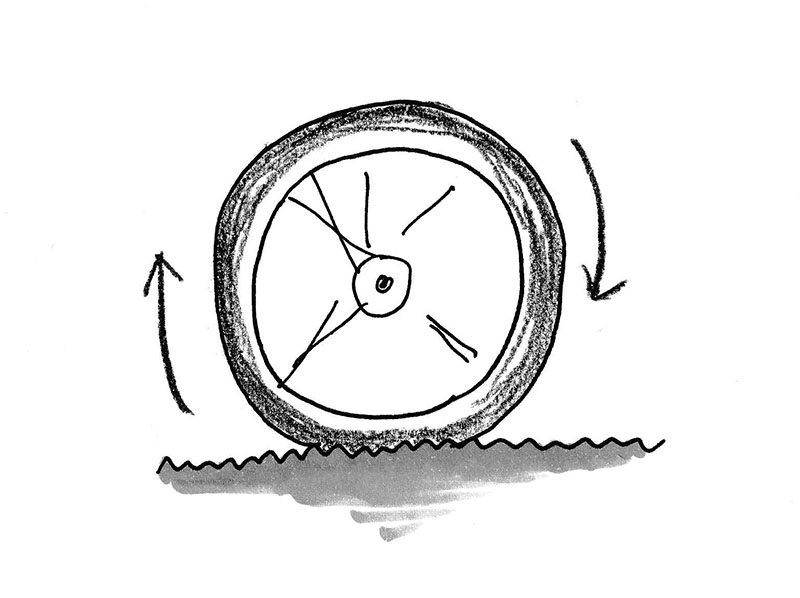
Pneumatic tires absorb road irregularities in the tire itself, without lifting bike and rider over the bump. That’s why they are so fast! Wheel size doesn’t really matter as long as the bumps are small enough that they can be absorbed by the tire.
To make a tire faster on bumpy terrain, you improve how well it absorbs those bumps, not how well it rolls up and over them.
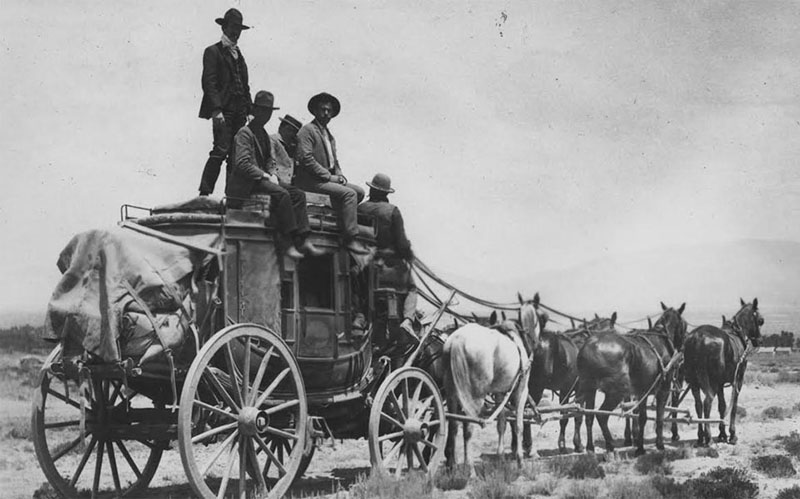
Before pneumatic tires, roll-over did matter. Wheels were as large as possible if speed and low resistance was desired. The stagecoaches of the Old West are a perfect example. They used huge wheels—as big as a horse!—for better roll-over. But that was more than a century ago… before pneumatic tires were invented.
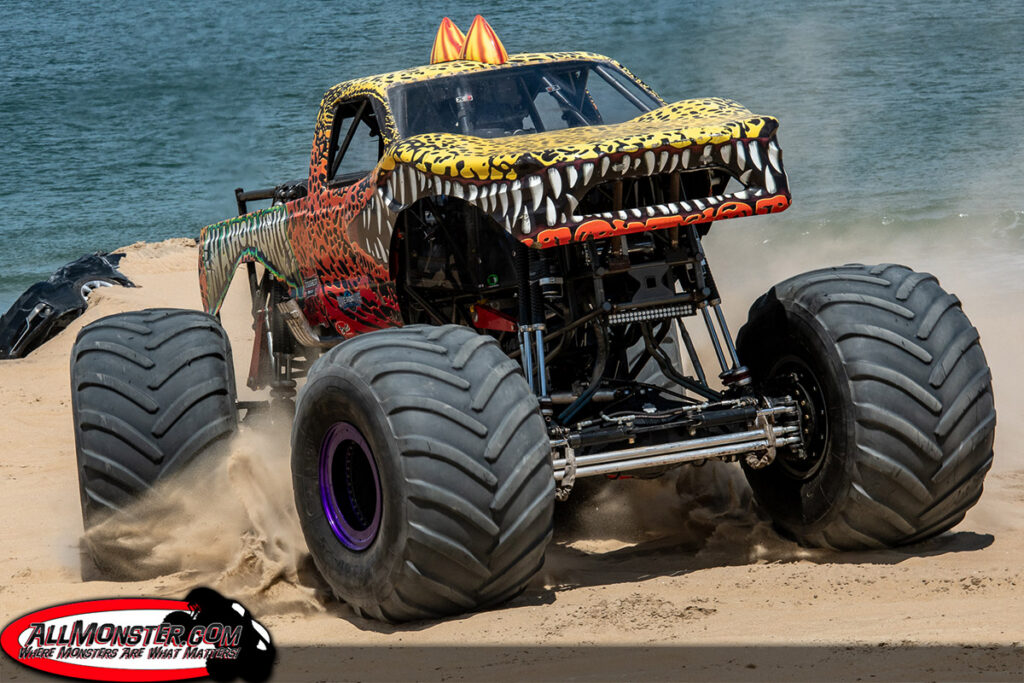
If large tires were significantly faster, you’d expect off-road racing trucks to have huge wheels. Those trucks exist. They are called ‘Monster Trucks’ for a reason. They are great for crushing old cars and putting on a show, but nobody uses them in races where the objective is to cover (rough) ground as fast as possible.
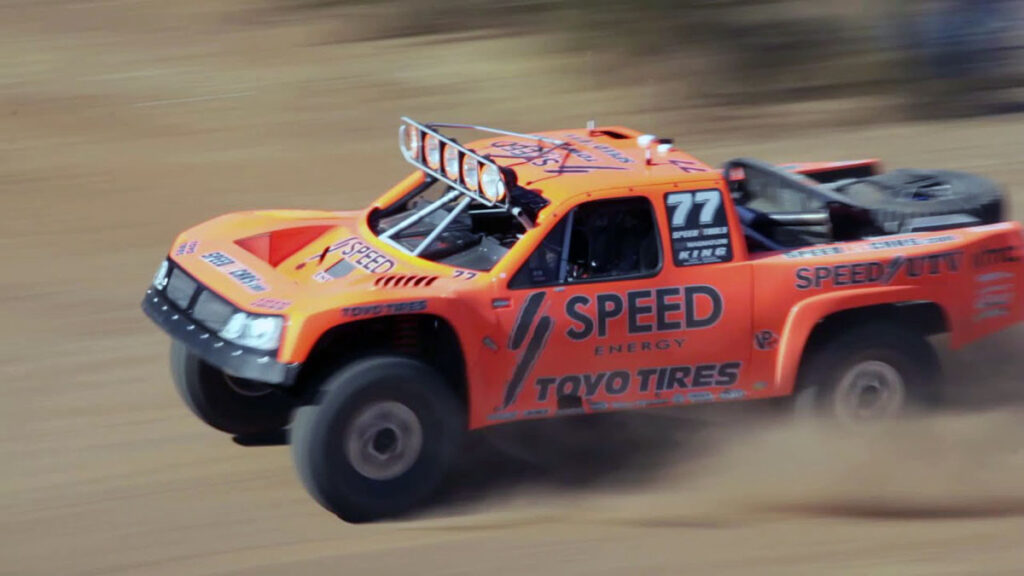
If you’re looking for all-terrain speed, check out ‘Trophy Trucks’ instead. With 1000+ horsepower, they compete in desert races like the Baja 1000 at incredible speeds. They aren’t really trucks: Underneath the fiberglass or carbon ‘truck’ body is a spaceframe chassis made from steel tubes. And Trophy Trucks run relatively small wheels—usually 17″—with huge 39″ tires. In metric measurements, the tires are a full meter in diameter. And yet the rims are smaller than those of the average family car.
Trophy Trucks show the way: What you want is a big tire that can absorb the bumps, not a big wheel that lifts the truck (or bicycle) over them.
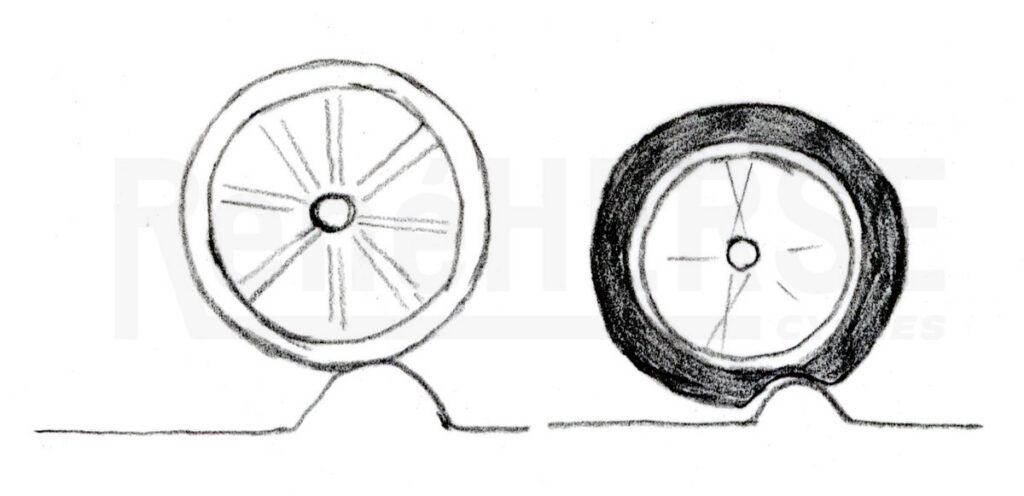
To summarize: A solid wheel (left) has to lift the bike/racecar/stagecoach over the obstacle. The larger the wheel is—compared to the bumps it encounters—the faster it rolls. Pneumatic tires (right) absorb bumps without lifting the bike/racecar. The better the tire absorbs the bumps, the faster it rolls over rough surfaces.
That’s the theory. Now let’s look at the science that backs this up.
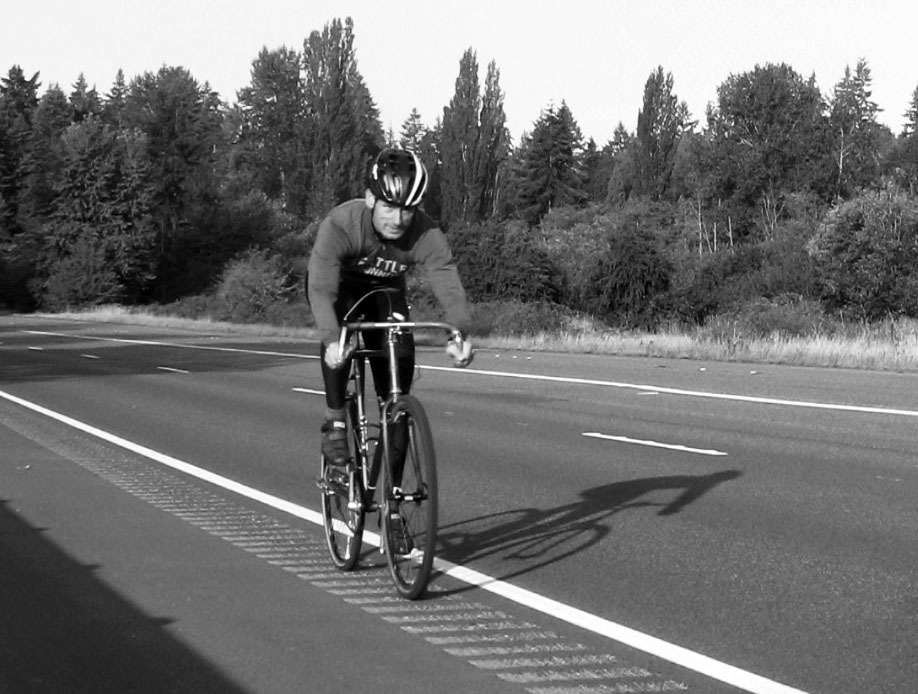
Way back in 2009, we wondered whether the then-new 650B wheels were slower than the 700C we’d been running until then. To test this, we came up with our famous rumble strip tests. Rumble strips on the side of a brand-new highway provide a perfect test track: a very rough surface right next to ultra-smooth pavement.
If you’ve ever accidentally ridden onto rumble strips on a highway shoulder, you know how rough they are. Your entire bike turns into a blur. They are a worst-case scenario of rough road surfaces. If large wheels have an advantage, it would certainly show up here.
Why rumble strips and not a gravel or cobblestone road? Rumble strips are uniform, so each test run is the same as the next. On gravel or cobblestones, the bike might roll on a smoother line during one test run, and then on a rougher line next time around. The brand-new, ultra-smooth pavement next to the rumble strips provides a reference surface. This allows us to check that nothing else—rider position, wind, temperature, etc.—has changed while we swap wheels to a different size. (Roll-over isn’t a factor on the ultra-smooth surface.)
We tested on a perfectly calm day with constant temperature. The bike was equipped with a precision SRM power meter. The rider kept the same position. (We independently confirmed in a wind tunnel that our test rider could adopt the same position time and again.) We tested at 5 a.m on a Sunday morning, so there was no traffic that might disturb the air. (The few times a car passed during a test run, we discarded the result and repeated the run.) We tested at 19.1 mph (30.7 km/h)—roughly the speed of top gravel racers.
We ran the same setup at least six times, alternating between the smooth pavement and the rumble strips. Then we took the average power for each surface and calculated error bars (dark gray below) that show how much of the measurement is ‘noise’ (slight changes in rider position, tiny wind currents, etc.), and how much is due to real differences between wheel sizes.
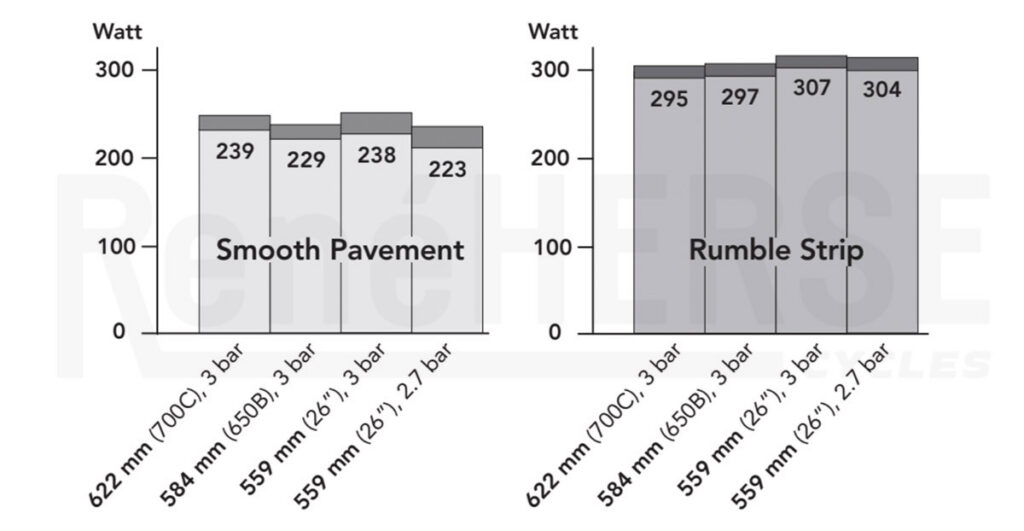
We found that small wheels roll as fast on rumble strips as the large ones. Above are the power measurements for each wheel size, plus the 26″ wheels with a slightly lower tire pressure. (We ran that as a check, to see whether small differences in tire pressure have a significant effect on our results. As expected, they didn’t.)
I can hear some readers say: “But the 700C wheels were fastest on the rumble strips!” Please look at the dark gray ‘error bars.’ They overlap, meaning that the tiny differences between wheel sizes are not statistically significant. (That’s also why we won’t say that 700C wheels are slower on smooth roads.) Those small differences are just inevitable noise in the data.
Others might say: “But you haven’t tested the new 32″ wheels!” It’s important to remember that there’s nothing fundamentally new about 32″ wheels. They’re just bigger. Of course, it’s possible that there is some threshold value that changes everything once you go beyond 700C. That is possible, but none of the explanations put forward so far have suggested that. What we’ve heard so far is: “Larger wheels roll faster.” And that statement is not supported by all the science we already have.
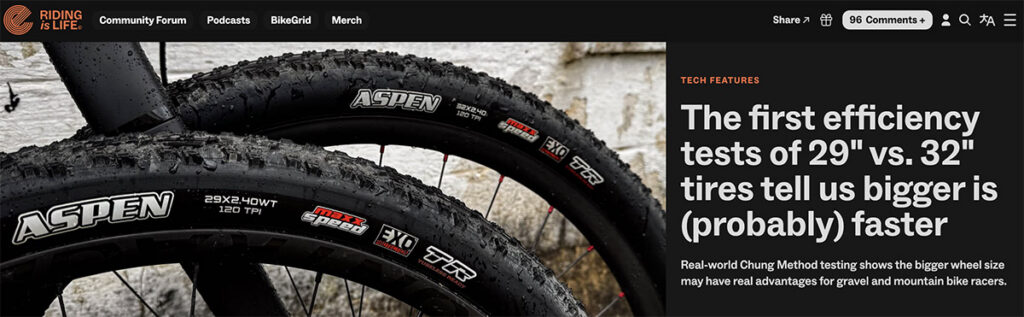
More recently, the Escape Collective published a test of 29″ vs 32″ wheels. They tested two bikes that were identical, except one used 29″ wheels, the other 32″ wheels. They tested on four surfaces: pavement, Category 1 (smooth) gravel, Category 2 (medium-rough) gravel, and rough cobblestones. Then they calculated the Coefficient of Rolling Resistance (Crr). As so often in the mainstream media, the headline was a little misleading: “Bigger is (probably) faster.”
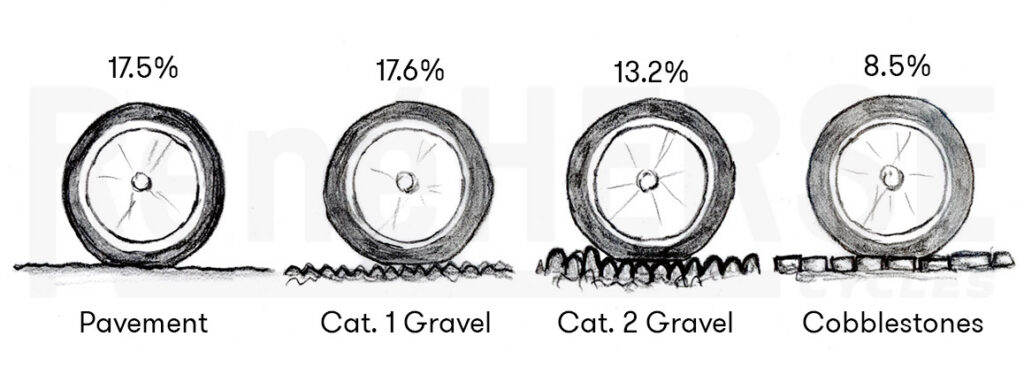
When you look at the actual data, you see that the advantage of the biggest wheels was largest on smooth pavement, and smallest on cobblestones. For the 32-inch wheels, the Escape Collective calculated an improvement of 17.5% on pavement and ultra-smooth Cat. 1 gravel, but only 8.5% on rough cobblestones. The Cat. 2 gravel was about half-way in between.
That’s the opposite of what you’d expect! If the roll-over was better, the advantage of the larger wheels would increase on rougher surfaces. Instead, the big-wheel bike offered the greatest improvement on smooth surfaces. Whatever made the 32-inch bike faster, one thing is clear: It wasn’t better roll-over!
The most likely explanation is some other factor that made the 32-inch bike faster. Perhaps the riding position was a little more aero? That would provide the biggest advantage on smooth roads, where other resistances (suspension losses, etc.) are (relatively) small. On rough roads, other resistances make up a larger portion of the total resistance, which reduces that particular advantage.
Taken at face value, the Escape Collective test suggests that 32-inch wheels provide the biggest advantage on pavement and smooth gravel. That doesn’t make sense. It also doesn’t match what we found in our testing, where the larger wheels didn’t offer a significant advantage—neither on smooth pavement, nor on rumble strips.
That’s why the headline is misleading: Yes, the 32-inch bike may have been faster, but it was not because of better roll-over. In the Escape Collective’s defense, they apparently did not look at the data at that level of detail before publishing their results.
The real conclusion from all this data is this: At least for the popular wheel sizes between 26″ and 32″, there is no measurable difference in performance.

Real-World Experience: What about the real world? Most gravel racers these days run 700C wheels, but that’s because most of today’s bikes come with them. Mark and I are outliers, since we’re running 26″ tires on the bikes we ride in gravel and bikepacking races. And yet we’re having no trouble keeping up. Whether it’s placing in the top-10 of all over-40 racers in Unbound XL (above at the finish after 25 hours of non-stop racing)…
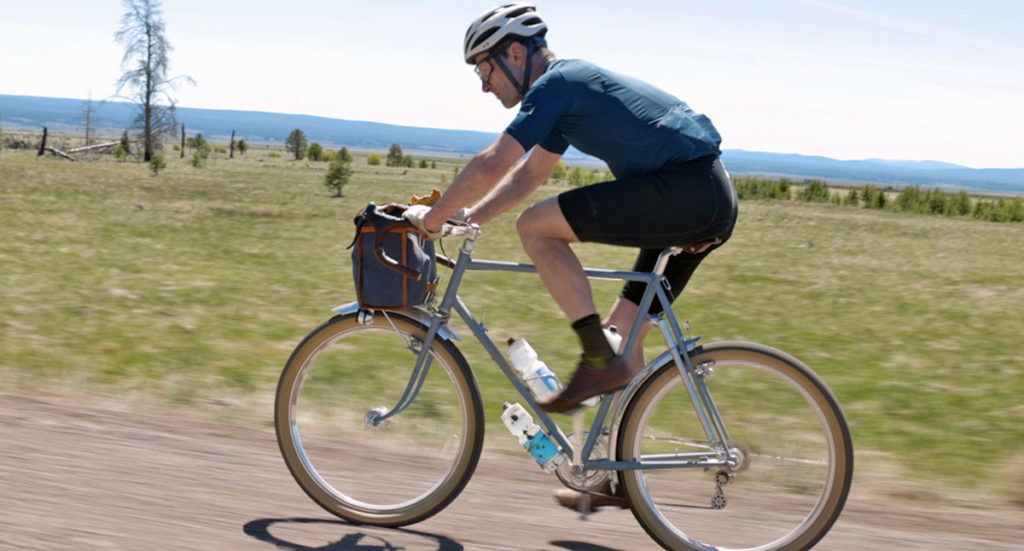
…or setting FKTs on bikepacking courses like the Oregon Outback (above), Dark Divide 300, Arkansas High Country Race or Oregon Cascade Volcanic Arc 400. The smaller wheels have no trouble keeping up.
Riding with in groups with other racers, we usually surge ahead when the surface gets rough, even though our wheels are smaller. That’s because we run 54 mm tires—much wider than the 42-45 mm tires of most of the other racers. You could say our bikes use the Trophy Truck formula: small wheels with big tires.
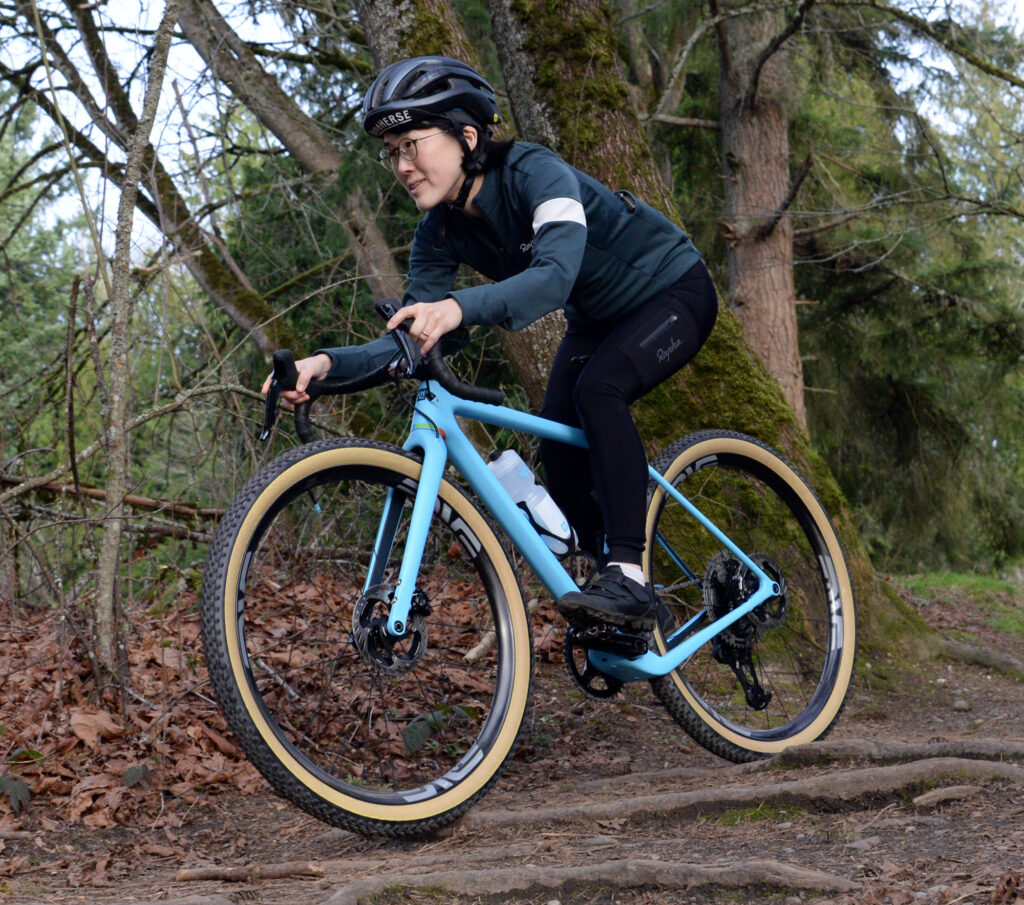
There are real reasons not to go to larger wheels. Obviously, the larger-and-heavier wheels accelerate (a little) slower. They also make it much harder to build a bike for smaller riders. To avoid toe overlap, they’ll require compromises in fit and handling.
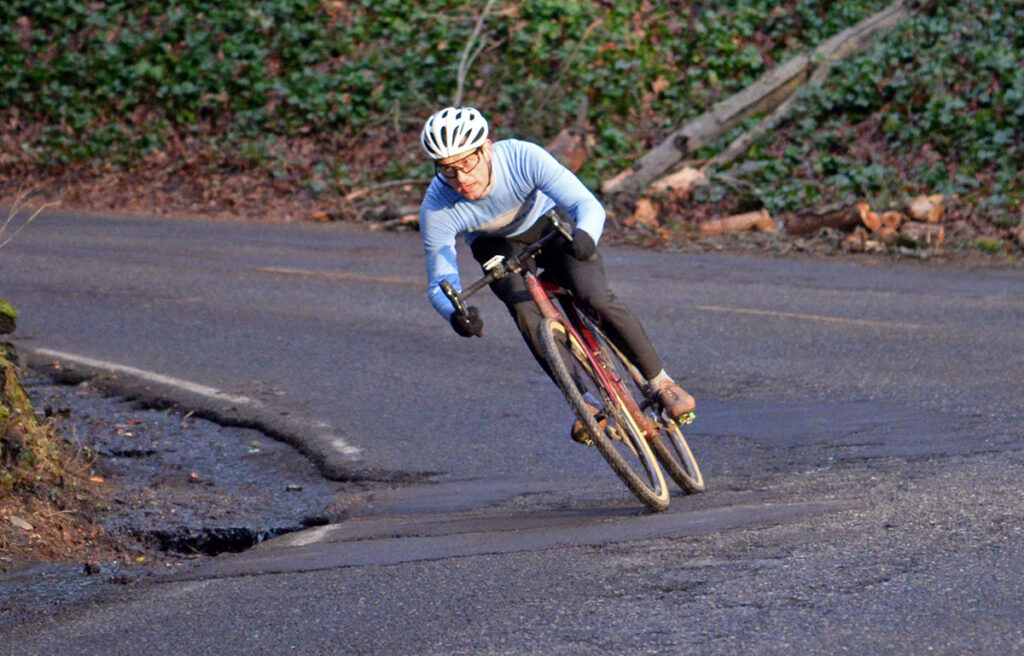
Even on large frames, big wheels make the bike handle differently. The greater rotational inertia of the larger (and inevitably heavier) wheels makes the bike more stable. However, 700C wheels with large tires already have plenty—many would say ‘too much’—stability, making them sluggish to respond to rider inputs unless you run superlight (and expensive) carbon rims.
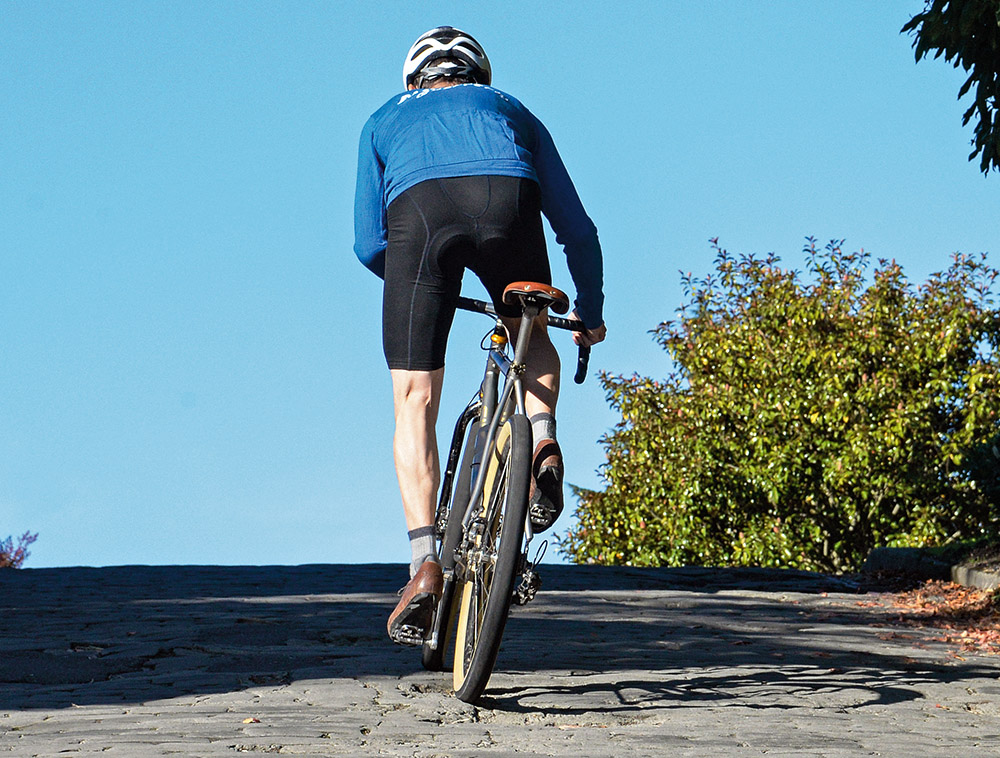
The rotational inertia is something you also feel when you climb or sprint out of the saddle. As you rock the bike, you accelerate it sideways, then stop and reverse the direction. At a cadence of 90 rpm, bike goes from right-to-left or left-to-right 3 times per second, with a full stop in between!
When you ride a fatbike or a mountain bike with plus-sized wheels, you’ll notice this: You can move your body on top of the bike, but it’s hard to rock the bike itself in sync with your pedal strokes. That effect is going to be even more pronounced with 32″ wheels. I think this is going to be the biggest obstacle to the widespread adoption of 32″ wheels. Once riders who aren’t industry insiders try them, many may find that the big-wheel bikes are too sluggish for their taste.
No matter the science, it seems that 32-inch wheels are coming in a big way. At Sea Otter this week, numerous makers will roll out tires, wheels and bikes for the new wheel size. We’re not the only ones who have doubts. Veteran bike journalist Zapata Espinosa joked in a comment about the industry’s difficulties: “Luckily 32″ wheels are on the way to save the day!”
How to go faster: At Rene Herse Cycles, we’re not averse to new ideas. After all, we were among the first to promote wide tires—but only after careful testing had shown their performance benefits. Our philosophy is that we won’t sell you things you don’t need. If you’re happy with the bike you’ve got, rest assured: Its smaller wheels don’t roll slower. If you want to make your bike faster on rough terrain, you’ll want to make your tires absorb those bumps better. Here’s how:
- Run the widest tire your bike can fit.
- Switch to a supple casing that still offers the durability you need.
- Optimize your tire pressure.
All testing (by us and others) has shown that those three steps will do more for speed on gravel and cobblestones than almost everything else.
Conclusion: If you’re curious about the new 32-inch wheels, we suggest going for an extended test ride that includes out-of-the-saddle sprints and twisty descents. The big wheels may not be faster, but they’ll feel different. If you like that feel, the new wheel size will give you new options. That can only be a good thing!
More Information:
- What about the greater momentum of larger wheels? We’ve covered that in this post.
- A detailed discussion of the Virtual Elevation Method used for testing 32-inch wheels.
- Rene Herse Tires with supple casings
- Rene Herse Tire Pressure Calculator 3.0
- Our book The All-Road Bike Revolution details the science behind the change from narrow, high-pressure to wide, low-pressure tires, and much, much more.
Photo credits: allmonster.com (Monster Truck); Robbie Gordon (Trophy Truck); unknown (Unbound XL finish); Rugile Kaladyte (Oregon Outback)