

TPU Tubes: How fast are they?
TPU tubes have been widely hailed as the ‘next big thing’ in the mainstream media. TPU tubes are lighter, faster and more durable than butyl tubes, while holding air far better than latex tubes. That brings up the question: How fast are they on real roads? The following article was originally published in Bicycle Quarterly 86. It has been lightly edited to match the format of the Rene Herse Journal.

Tests on steel drums show TPU tubes rolling faster than butyl tubes. The big questions is: Does this translate into the real world?
There is reason to be skeptical: Stiff tires roll faster on steel drums, but slower on real roads. Lab tests without a rider do not measure suspension losses—energy dissipated inside the rider’s body—and thus favor stiff tires. Many tire makers have been moving to harder tread rubber, because it tests better on steel drums. In the real world, the harder rubber actually rolls slower. Would the same apply to TPU tubes? Would they only provide a benefit in the lab, but roll slower on real roads?
As we considered developing our own TPU tubes for Rene Herse Cycles, this question became urgent and pressing. We did not want to develop a tube that, while lighter and more durable, made our bikes slower on real roads. We had to test the performance of TPU tubes—and we had to do it quickly!
The Perfect Test Location
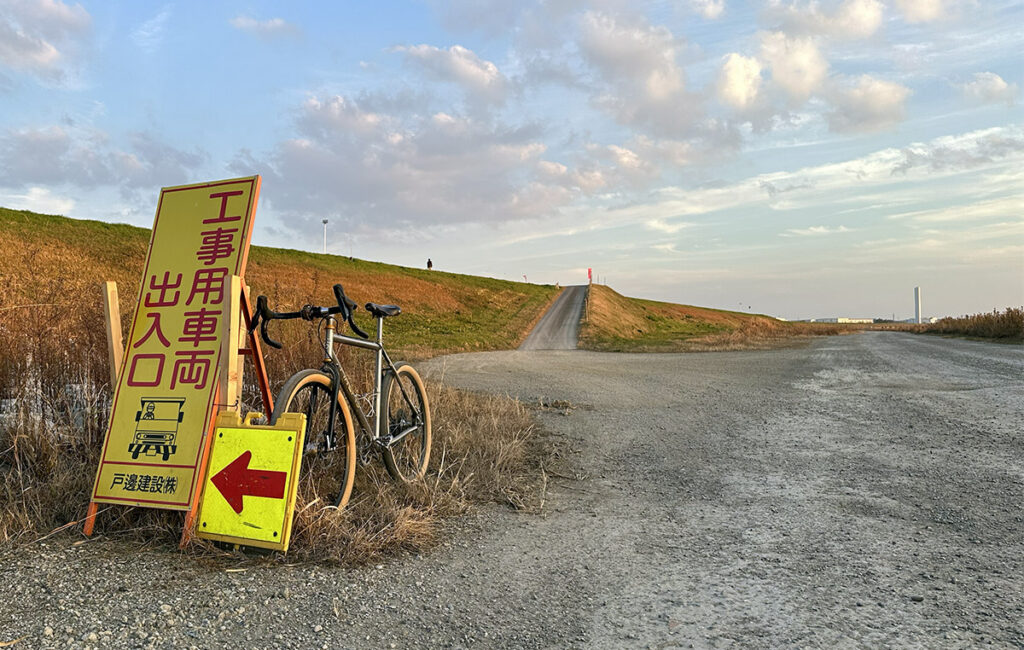
Japan’s Kanto Plain is made of many small depressions, so there are many roads that are perfect for roll-down tests of tire and tube performance. We were looking for a road that starts with a relatively steep slope, then flattens out to at least 200 meters (656 ft) at a constant 2%. The steep start allows the bike to pick up speed quickly, so there’s little time spent at ultra-low speeds, where wobbles can affect the rate of acceleration. The 2% grade results in a constant speed of about 6 m/s (21.6 km/h; 13.4 mph)—fast enough to be representative of real-world riding, but slow enough that aerodynamic resistance does not drown out other factors. (The actual testing was performed on a paved road with a similar profile to the one shown above.)
Japan in winter often sees days of absolute calm, with no measurable wind at all. This adds greatly to the precision of our measurements. (You can measure wind speed and direction, and then correct for the influence of wind, but this adds a layer of complexity and introduces potential errors.)
For this test, we used the same bike (Firefly titanium), the same wheels and the same set of 26” x 2.3” Rat Trap Pass Extralight tires. We switched between extralight butyl tubes (Schwalbe SV 14A; 95 g) and prototypes of the Rene Herse TPU tubes (48 g). To do this, we removed the tires and exchanged the tubes between tests. All tubes were inflated to 1.8 bar (26 psi), the ‘soft’ value of the Rene Herse Tire Pressure Calculator.
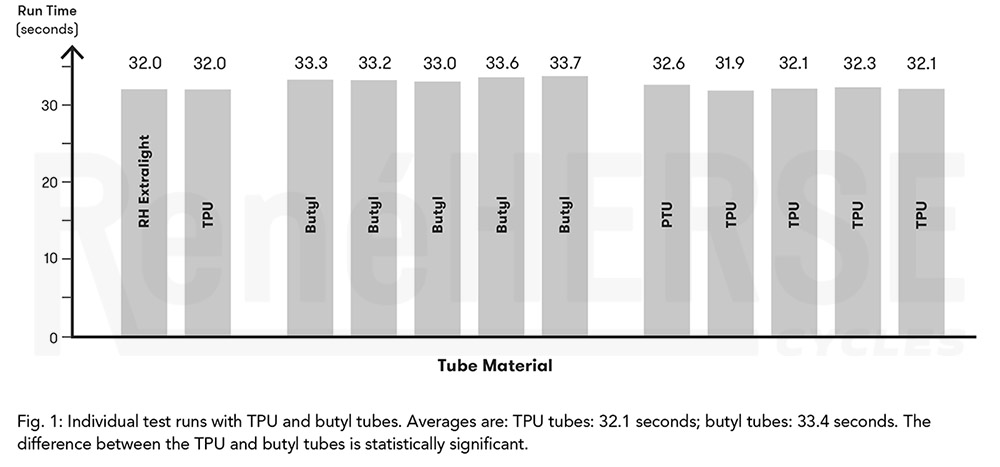
We did three runs with the TPU tubes, then changed to butyl tubes for six runs, before doing another six runs with TPU tubes.
We did not record the first run each time after changing the tubes. Tubes tend to move slightly immediately after installation, before they settle into their final position, and these first runs tend to be very slightly slower than later runs. This applies consistently to TPU and butyl tubes.
Running TPU tubes at the beginning and the end of the test series ensures that conditions haven’t changed over the period of the test. The testing was performed over a period of one hour on a day with zero wind and constant temperature. (Speedy tire mounting is essential for these tests!)
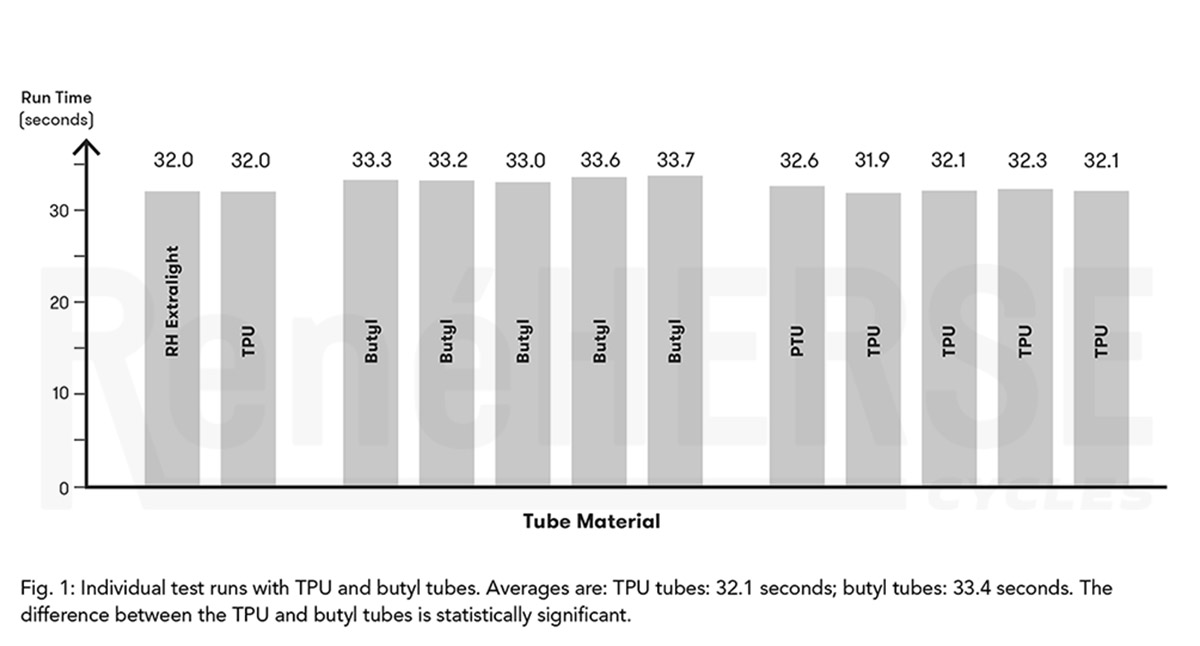
The results for each tube were extremely consistent, showing that other factors, like wind, rider position, temperature, etc. did not change during the testing.1 All runs with the TPU tubes fell within a narrow range, between 31.9 and 32.6 seconds (Fig. 1). The runs with butyl tubes took between 33.0 and 33.6 seconds. There was no overlap between the results for TPU and for butyl tubes. On average, the TPU tubes were 1.3 seconds or 3.6% faster. These differences are statistically significant.
Translated to Watts
To determine the power savings of the TPU tubes, we calculated the Crr (Coefficient of Rolling Resistance) for the two sets of runs (TPU and butyl tubes), using input parameters determined in wind tunnel testing and verified in real-road tests with power meters.2
We did the same for our previous tests that compared butyl tubes to ultra-thin latex tubes3—the same type used in high-end tubular tires. Weighing just 54 g each, these tubes are much thinner and lighter than standard latex tubes that weigh 132 g (Vittoria) in the same size. The ultra-thin latex tubes represent a ‘best-case’ scenario for latex tubes. Commonly used latex tubes are thicker, heavier and likely slower than the latex tubes we tested.
We found is that the performance of TPU tubes and ultra-light latex tubes is indistinguishable. (The small difference in our results is not statistically significant.)
In the past, we also tested tubeless setups compared to standard-thickness butyl tubes.4 We used the same methodology as in the test of TPU vs. butyl tubes: We first ran the same tires with butyl tubes, then removed the tubes and installed the tires tubeless, using a minimum of sealant, making this a best-case scenario for tubeless tires. Then we ran tubes again. Our back-to-back testing found that tubeless tires roll at the same speed as butyl tubes. Apparently, the liquid sealant inside the tires causes as much resistance as the added membrane of the butyl tube.
We then calculated the power requirements for each setup and compared that with the differences between different tires from Rene Herse and other manufacturers.
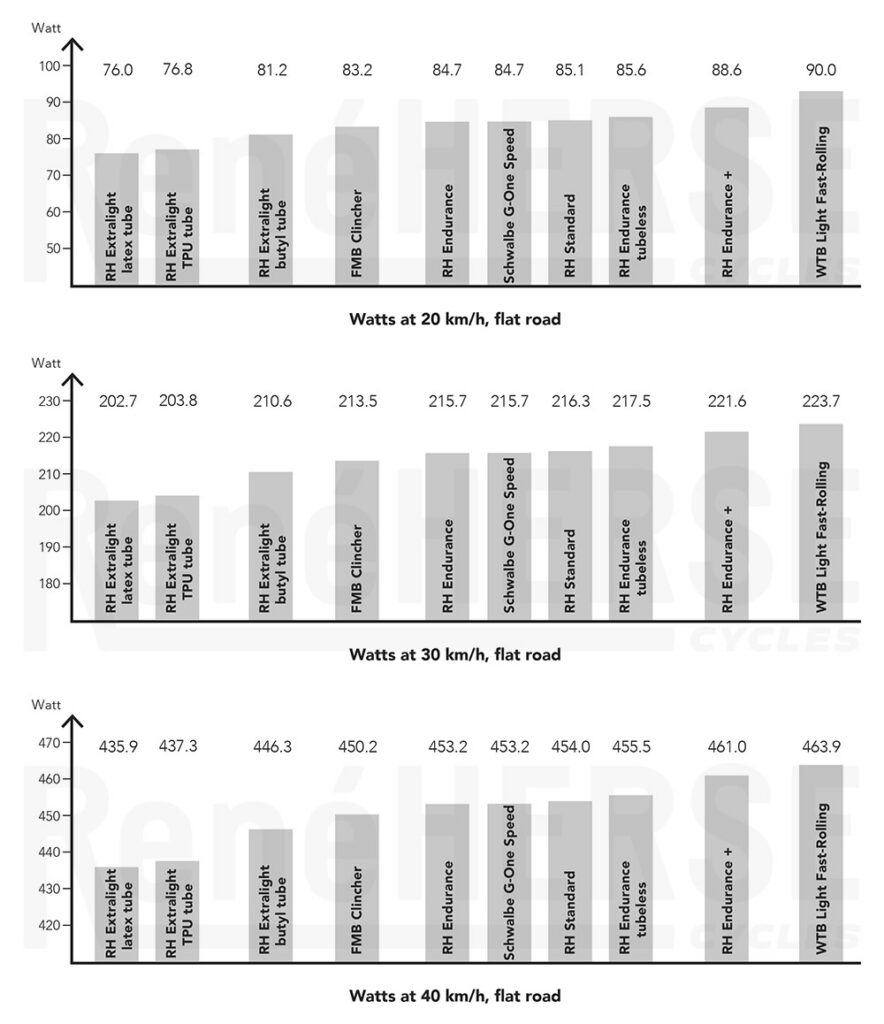
Both the TPU and the latex tubes are significantly faster than butyl tubes and tubeless setups. (Grouped bars show tire/tube setups where the results are not statistically significant.)
Compared to the ultralight butyl tubes, the TPU tubes save
- 4.4 watts at 20 km/h (13 mph)
- 6.8 watts at 30 km/h (19 mph)
- 9 watts at 40 km/h (25 mph)
This is similar to the savings of switching from Rene Herse Standard to Extralight casings.
As a percentage of the total power output, the savings are greater at lower speeds: TPU tubes make a 20-km/h-rider 5% faster, whereas a 40-km/h-rider saves only 2%. For casual riders, saving 5% allows them to ride further and keep up with friends without less strain. For racers, who compete with others with similar power-to-weight ratios, a saving of 2% is highly significant and can make the difference between winning a race or not even finishing on the podium.
Conclusion
The performance benefits of TPU tubes are real and borne out in real-road tests. If anything, TPU tubes perform even better in the real world, with a rider on the bike, than in lab tests on steel drums—a phenomenon also observed with supple tires. TPU tubes are as fast as ultra-thin latex tubes. TPU tubes are significantly faster than butyl tubes or tubeless setups. (They are also stronger, lighter and offer better ride feel than butyl tubes.) Based on these results, we went ahead with the development of our Rene Herse TPU tubes, confident that they would provide a real-world benefit for us and our customers.
More Information:
- Rene Herse TPU Tubes
- Bicycle Quarterly, the magazine with research about real-road bicycle performance
Notes:
1 The consistent runs for each tube setup show that extraneous variables, like changes in rider position (and aerodynamics), tiny air currents and/or changes in temperature did not significantly affect the results. The statistical analysis shows a very high probability that the observed differences between butyl and TPU tubes are due to actual performance differences and not random ‘noise’ in our data. See also: How We Tested Tires. Bicycle Quarterly 78 (Autumn 2020), p. 70.
2 Frontal area = 0.5 m2; Cd = 0.9; Weight (bicycle + rider) = 80 kg
3 Are latex tubes faster? Bicycle Quarterly 74 (Winter 2020), p. 102.
4 Testing tires: How fast do they roll? Bicycle Quarterly 73 (Autumn 2020), p. 70.